Borderlands (Zev Berman, 2007): 6.5/10

The Magic Flute (Ingmar Bergman, 1975): 7/10

La Guerre Est Finie (Alain Resnais, 1966): 7/10

Speed Racer (The Wachowski Brothers, 2008): 8/10


My Photo
Name:
Location: milwaukee, wi

Saturday, February 10, 2007

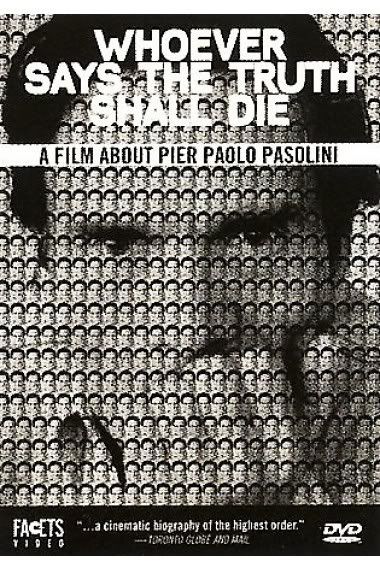
Whoever Says the Truth Shall Die (Philo Bregstein, 1981)


There are few cinematic lives as thoroughly interesting as that of Pier Paolo Pasolini (Fassbinder - of course - is the only one I can think of at the moment). Born of an anti-fascist mother and a Mussolini-supporting father, Pasolini taught school before being fired (although found innocent) for supposedly having sexual relations with his students. He moved to Rome, began writing a lot of highly political poetry, fell in with the Italian Communist party, then was eventually kicked out of the party because he refused to fall in line with the party on every issue. In the meantime, he not only wrote poetry, but novels, his own movies, and helped with other directors' movies (such as Fellini). He was outspoken in his radical political views, which caused him to make Salo, and then was murdered, either by a teenage hustler (the official, government view) or by government assassins (pretty much everyone else's view).

While all these facts make for one incredibly interesting life, Philo Bregstein's 1981 documentary is remarkably dull. It's worth a watch for people interested in the life of this brilliant, tormented man, especially for the interviews with Bernardo Bertolucci, who provides some personal insights into his life and death. The other interviews are rather hit or miss, and we hear surprisingly little from the man himself. All that aside, it's a worth effort, but more than anything, it made me wish someone would make a real, full-length (this is only little less than an hour) documentary on the incredibly controversial life of this under-appreciated genius.

6/10

Labels: , ,

StumbleUpon Toolbar Stumble It!

Thursday, February 01, 2007

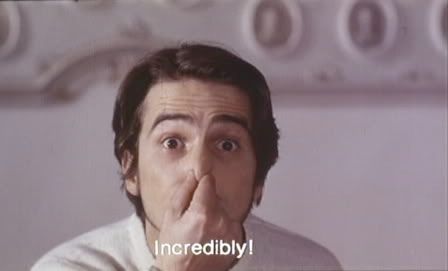
Porcile (Pier Paolo Pasolini, 1969)


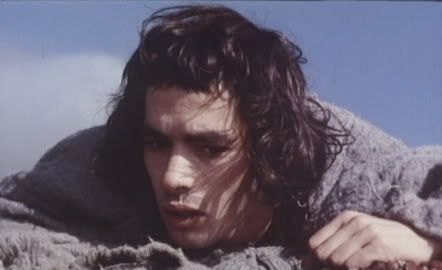
Porcile is a criminally overlooked Pasolini triumph, the kind of bourgeoisie-smashing experiment that preceded Salo in both theme and style. Salo is the more famous and notorious of the two, but Porcile is equally damning of the dominant social structure. In the parallel stories, Jean-Pierre Leaud plays the son of a Nazi industrialist who has a big, big secret; and Pierre Clementi plays a young man in medieval times who kills and eats several people and finds his end at the hands of the church.


Leaud is wonderful in the role of Julian, a man who doesn't care about life, doesn't care about his girlfriend (Anne Wiazemsky, who was Mrs. Godard for a while in the 70s), and eventually falls into a coma-like state because of his ennui. He wakes up just in time for Ida to leave him, but he has a secret love that speaks volumes for Pasolini's feelings toward the upper-classes, especially those who profited during the second World War. Leaud's performance is quiet and disturbing, and while I couldn't stop thinking of him as Antoine Doinel (that's what happens when you take on a character so fully, I suppose), he plays Julian with the desperate emptiness the character embodies. Julian's father, who is the focus of the present-day story while Julian is in a coma, was a Nazi collaborator who now joins forces with another German industrialist in order to hide their collective pasts.


The second story, about the young cannibal, is less compelling, but simply because there are less dialogue and empathetic characters. The story is almost psychedelic at times, and when the religious elements come to punish the main characters, it reaches a fever pitch of imagery and meaning. Pasolini's direction is, as always, stupendous and beautiful, even though the DVD has a rather terrible transfer, subtitles that are in the middle of the screen, and possible dubbing (Leaud doesn't sound like himself, but the dubbing itself isn't bad). If ever there was a movie in need of a total restoration, this is it. Come on, Criterion Collection!


8/10

Labels: ,

StumbleUpon Toolbar Stumble It!

Saturday, January 13, 2007

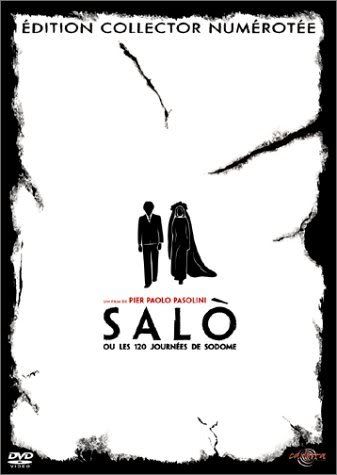
Salo (or the 120 Days of Sodom) (Pier Paolo Pasolini, 1975)


Note: this entry is taken almost entirely (although edited for more clarity) from my movie journal ramblings the day after watching Salo. It took me a little while to be able to get my thoughts on paper, but once I started, it was hard to stop.

I finally saw Salo after years of seeking it, having heard that it's the most disturbing film of all time. This is a movie whose reputation always precedes it, but it's also a film that I can say without (much) pretension that most people who have seen it aren't smart (or educated, more likely) enough to really appreciate it. There are so many posts on IMDB (my guilty pleasure of the film world) about how it's not shocking or disturbing or whatever someone may have expected. This isn't a film for 16 year old gore freaks, as it may have been portrayed to be. A lot of people, it seems, come into this film expected Guinea Pig, and they're sorely disappointed. Instead, it's about human cruelty, life during wartime, things like that. If someone doesn't at least understand the basics of Dante's Inferno and Italisn fasciscm, they won't completely (as completely as one can, anyway) get what Pasolini was trying to say, pure and simple. Sure, many of the actions shown are shocking in and of themselves, but just to take them as that (and more, to be disappointed in the non-shocking nature of those acts in a void) is immature and ignorant. This is possibly the most misunderstood movie of all time.

The one element that sticks out to me above all others to write about (although what a tough choice that was!) is Pasolini's decision to base the film solely on the persepctive of the victimizers, in direct contrast to that of the victims. The president, his libertine companions, the whore-storyteller - these are the only people that we as the audience get to know. They are in plain view, yet enigmatic; completely taboo- and secret-less, yet not completely understandable (based on their very committment to depravity and full disclosure). We only see the victims through the eyes of those in power, and I actually began to feel disgust for the victims from time to time. The only things the victims say are basically pleas - to their captors, to their god, to whomever will listen. Then, near the end of the film, they turn on one another in order to avoid punishment. We, like their captors, want to find out their secrets, and at the same time are disgusted they would stoop so low as to sell one another out to avoid their inevitable fate. But it shouldn't be surprising - the whole film, the victims are almost infuriatingly meek, unwilling at all to stand up (except one unfortunate girl, who takes her fate in time anyway), defend themselves, challenge their fates - nothing.

We get angry with these children (because they are little more than that) and their weaknesses until we realize that we have fallen right into Pasolini's trap! How easy it is to hate the victim! How simple it must have been for fascism to succeed in Italy! And so on. So in his great brilliance, Pasolini puts the audience simultaneously in both groups' shoes: we are disgusted by the victims for being so weak (and reflecting in ourselves the same qualities), we see human nature (however disgusting and brutal) apparent in the captors; yet we are the same as the victims - we, without argument, swallow the scenes set before us, as disgusting as we find them. And we do swallow our fate in watching the film blindly, but it doesn't change anything, just the same as the victims' meekness changes nothing in their fate as well! That's what the victims realized, and so there we are, right back at the beginning of Pasolini's vicious cycle.

An impossible movie to truly enjoy watching (or to give a number rating), Salo is yet a brilliant one, the most misunderstood, misinterpreted in film history. It is also arguably one of the most important films ever made, one that caused the murder of its genius creator. The Criterion disc states that Pasolini's goal was to impart this lesson: "Moral redemption may be nothing but a myth." That's heavy stuff, something few people willingly want to think about, but one Pasolini wanted to force us to. He is very successful, but the notoriety associated with the film does nothing but harm its intellectualism. Maybe when Criterion rereleases this film sometime this year, and it becomes readily available and not rare, will these issues be thought of popularly as a part of the movie, not just the shit-eating. Salo is a trial, one worth undertaking, but only if one is willing to accept the intellectual/spiritual challenges, not only the fortitudinal one.

Labels: ,

StumbleUpon Toolbar Stumble It!

Saturday, November 18, 2006

Accattone (Pier Paolo Pasolini, 1961)


There are few directorial debuts as impressive as Pasolini's Accattone. The master who would go on to direct Teorema and Salo (which I still have not seen), among other controversial classics, and who would be murdered under very suspicious circumstances right after the release of Salo, started his directorial career with this tale of Accattone, a Roman pimp who struggles to survive in post-war Italy. Accattone, at the beginning of the film, is pimping Maddalena (Silvana Corsini, who is beautiful and magnetic in a strange way, which is how I feel about many of Pasolini's heroines), who has a broken leg, yet is forced out onto the street anyway. She is picked up by a group of guys, then, in the film's most disturbing sequence (to me), is beaten up, raped, robbed, and left for dead in the middle of nowhere. Although she is able to identify her attackers to the police, they somehow get out of jail and she is put in jail for a year for perjury. This, rather than most of the overt poverty and squalor, is what upset me most about the movie, the asking-for-it and victim blaming mentality of this society. Accattone doesn't even care when he finds out Maddalena is in jail, despite being not only his main source of income, but also (probably) his girlfriend. Accattone falls in love with proper, naive Stella, and eventually gets her on the street, as well.

This is my favorite Italian neo-realist film I have seen so far, with the brutality of the Italian economy beating down these characters. If it is this impossible for people who do not have "legitimate" jobs to survive, one imagines what it must have been like for the other sectors of society. The jobs characters are shown having are either Stella's work cleaning bottles, for which she says she gets paid just enough not to starve, and Accattone's one day of work hauling six tons of steel into a truck. This is a society beaten down by war, being the loser in a gigantic war, and the citizens that inhabit this story barely survive. The most poignant and painful moment in the film comes when Accattone visits his young son, who doesn't recognize him, and steals a gold necklace from him, just to pawn for a little bit of cash.

Neo-realism doesn't get much more depressing than this, but the beauty of human life shines through in little pieces, such as flowers, stars, or Stella's pretty dress. The inevitably tragic ending underscores that these little things are what make life worth living, as everything comes crashing down in the end anyhow. Although Pasolini would probably scoff at my optimistic view, I like to think that in order to not let this beautiful film crush a part of my spirit.

A quick note on the DVD itself: it's terrible. The transfer is crappy, the white subtitles against a black & white print make them intelligible at times (and there are even missing subtitles at points), and, worst of all, there are no DVD chapters. Just a warning; however, the movie is well worth seeing, even through the terrible DVD. Criterion, issue this movie! A Pasolini box set is well past due.

8/10

RIYL: Roberto Rossellini, Bernardo Bertolucci (who was the AD on this movie)

Labels: ,

StumbleUpon Toolbar Stumble It!