Borderlands (Zev Berman, 2007): 6.5/10

The Magic Flute (Ingmar Bergman, 1975): 7/10

La Guerre Est Finie (Alain Resnais, 1966): 7/10

Speed Racer (The Wachowski Brothers, 2008): 8/10


My Photo
Name:
Location: milwaukee, wi

Tuesday, March 04, 2008

Graveyard of Honor (Kinji Fukasaku, 1975)


Kinji Fukasaku's 1975 film Graveyard of Honor isn't your usual yakuza film. There's no glorification of the yakuza lifestyle; instead, we get the story of one man who takes it too far. It's more like a Scorcese or other American gangster picture where there are almost always a renegade who feels the consequences of his actions, rather than a Japanese yakuza picture, which usually shows the yakuza as the hero, rebelling against status quo society. In fact, I wouldn't be surprised if we saw an American remake one -- Takashi Miike already remade it, and I have read alternating account that it's one of his best or most boring pictures.

We learn, from a lengthy voiceover introduction, that Rikio Ishikawa ran away from home at 15 and joined the Tokyo yakuza. When we first see him, he's an impulsive young man, straight out of juvenile detention, who attacks some small-time yakuza who are operating a shoe-shine business in his gang's territory. His boss tries to warn him that unless someone is a genuine threat, there's no need to attack them and make things worse. But Rikio is impulsive and arrogant, and because he can't keep his temper in check, causes lots of problems for his gang. He's eventually banished from Tokyo for ten years and goes to jail, but when he gets out, things are worse than ever.

Fukasaku, a director of considerable talent (he directed Battle Royale, among others), shows here that he's a visual master. Some of the shots are sideways, and in the fight scenes, it's often hard to get a hold on what's happening. The cinematography is often disorienting, a wonderful look inside of Rikio's head. Even though some of the plot is overdrawn and confusing (why does his gang keep forgiving him?), it's a good movie and well worth a watch, if only to see where modern Japanese directors like Miike got much of their yakuza inspiration.

7.5/10

Labels: ,

StumbleUpon Toolbar Stumble It!

Tuesday, June 12, 2007

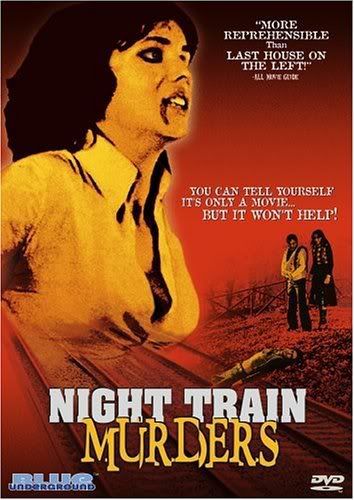
Night Train Murders (Aldo Lado, 1975)


One of the films Eli Roth name-checked and raved about during the Q&A I attended (thus I had to see it), Night Train Murders was envisioned by its producer, and inevitably marketed, as "Last House on the Left...on a train!" I am not a big fan of the Wes Craven original (neither did I like The Hills Have Eyes but loved Alexandre Aja's remake, go figure), but I definitely wanted to check this out because of how Roth described it as a big influence on Hostel Part II. Am I glad that I did, not only because I enjoyed the film itself, but also because it shed some light on Roth's sequel (that scene on the train couldn't have been more influenced by this movie). As you might have guessed, the film follows two college girls who take a train from Germany to Italy for Christmas and meet some very unsavory characters. If you've seen Last House on the Left, you can imagine what comes next.

Although Night Train Murders necessarily has a more convoluted plot than LHotL (why did everyone get on that second train?), it is ultimately more disturbing and effecting than Craven's movie because of Lado's underlying social criticism. Although there is very little gore and no nudity in the film, it was banned in England and became one of the video nasties (and, according to wikipedia, is still banned in the UK today). Why? The only answer is because of the disturbing social commentary that lies underneath. The villians of the movie are two drug-addicted thieves, and an upper-class woman that they meet on the train and who orchestrates all the rest of the goings-on. The woman, played by Macha Meril, is delightfully cold and evil, but not so much that it feels unrealistic. The scariest thing about this film is that 30 years later, I feel this could still happen. I feel it could happen to me.

The bonus material on the DVD includes an interview with Lado in which he talks about exactly what he wanted to do with the film, including the commentary he wanted and the fact that he had never (and still has never) seen Last House on the Left. He took a template that a money-hungry producer gave him and made it his own, the sign of a true filmmaker. This is opening my giallo floodgates, and should be seen by anyone who loves a subtext to their thrills.

Labels: ,

StumbleUpon Toolbar Stumble It!

Saturday, January 13, 2007

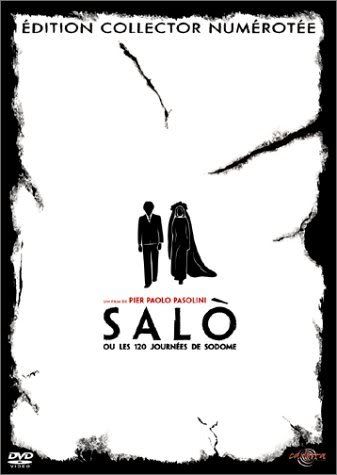
Salo (or the 120 Days of Sodom) (Pier Paolo Pasolini, 1975)


Note: this entry is taken almost entirely (although edited for more clarity) from my movie journal ramblings the day after watching Salo. It took me a little while to be able to get my thoughts on paper, but once I started, it was hard to stop.

I finally saw Salo after years of seeking it, having heard that it's the most disturbing film of all time. This is a movie whose reputation always precedes it, but it's also a film that I can say without (much) pretension that most people who have seen it aren't smart (or educated, more likely) enough to really appreciate it. There are so many posts on IMDB (my guilty pleasure of the film world) about how it's not shocking or disturbing or whatever someone may have expected. This isn't a film for 16 year old gore freaks, as it may have been portrayed to be. A lot of people, it seems, come into this film expected Guinea Pig, and they're sorely disappointed. Instead, it's about human cruelty, life during wartime, things like that. If someone doesn't at least understand the basics of Dante's Inferno and Italisn fasciscm, they won't completely (as completely as one can, anyway) get what Pasolini was trying to say, pure and simple. Sure, many of the actions shown are shocking in and of themselves, but just to take them as that (and more, to be disappointed in the non-shocking nature of those acts in a void) is immature and ignorant. This is possibly the most misunderstood movie of all time.

The one element that sticks out to me above all others to write about (although what a tough choice that was!) is Pasolini's decision to base the film solely on the persepctive of the victimizers, in direct contrast to that of the victims. The president, his libertine companions, the whore-storyteller - these are the only people that we as the audience get to know. They are in plain view, yet enigmatic; completely taboo- and secret-less, yet not completely understandable (based on their very committment to depravity and full disclosure). We only see the victims through the eyes of those in power, and I actually began to feel disgust for the victims from time to time. The only things the victims say are basically pleas - to their captors, to their god, to whomever will listen. Then, near the end of the film, they turn on one another in order to avoid punishment. We, like their captors, want to find out their secrets, and at the same time are disgusted they would stoop so low as to sell one another out to avoid their inevitable fate. But it shouldn't be surprising - the whole film, the victims are almost infuriatingly meek, unwilling at all to stand up (except one unfortunate girl, who takes her fate in time anyway), defend themselves, challenge their fates - nothing.

We get angry with these children (because they are little more than that) and their weaknesses until we realize that we have fallen right into Pasolini's trap! How easy it is to hate the victim! How simple it must have been for fascism to succeed in Italy! And so on. So in his great brilliance, Pasolini puts the audience simultaneously in both groups' shoes: we are disgusted by the victims for being so weak (and reflecting in ourselves the same qualities), we see human nature (however disgusting and brutal) apparent in the captors; yet we are the same as the victims - we, without argument, swallow the scenes set before us, as disgusting as we find them. And we do swallow our fate in watching the film blindly, but it doesn't change anything, just the same as the victims' meekness changes nothing in their fate as well! That's what the victims realized, and so there we are, right back at the beginning of Pasolini's vicious cycle.

An impossible movie to truly enjoy watching (or to give a number rating), Salo is yet a brilliant one, the most misunderstood, misinterpreted in film history. It is also arguably one of the most important films ever made, one that caused the murder of its genius creator. The Criterion disc states that Pasolini's goal was to impart this lesson: "Moral redemption may be nothing but a myth." That's heavy stuff, something few people willingly want to think about, but one Pasolini wanted to force us to. He is very successful, but the notoriety associated with the film does nothing but harm its intellectualism. Maybe when Criterion rereleases this film sometime this year, and it becomes readily available and not rare, will these issues be thought of popularly as a part of the movie, not just the shit-eating. Salo is a trial, one worth undertaking, but only if one is willing to accept the intellectual/spiritual challenges, not only the fortitudinal one.

Labels: ,

StumbleUpon Toolbar Stumble It!

Friday, December 29, 2006

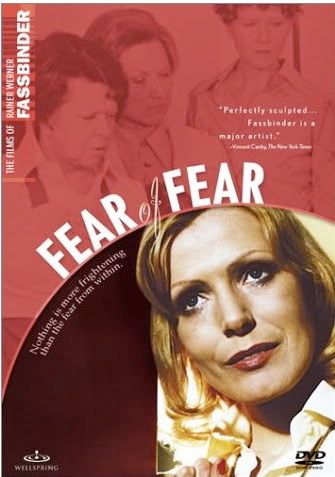
Fear of Fear (RW Fassbinder, 1975)


Fear of Fear is a TV movie made by Fassbinder in 1975, at the beginning of the height of his German popularity. The plot does indeed sound like the modern, American version of TV movies: Margot (Margit Carstensen), housewife and mother of two children, becomes increasingly bored and anxious with everyday life. She becomes convinced that she is going insane, and even submits to a quasi-affair with the doctor across the street. The whole time, no one listens to her, and everyone simply provides her with valium to relieve her anxiety. They are not uncaring (well, at least her husband isn't), it's just that this everyday world makes it nearly impossible to care deeply about someone other than oneself. It sounds like total Lifetime Channel material, but Fassbinder has this way of taking everyday melodrama and turning it into something extremely meaningful and almost universal. Nowhere is this more apparent than in Fear of Fear, one of his lesser works, but one of my favorites.

I have relatively little to say about the acting and writing, other than the fact that both are tremendously effective and moving. This film is so amazingly directed that I actually took some notes on it while watching! There are countless perfectly choreographed scenes, especially the ones where Margot bumps into the mysterious Mr. Bauer on the street. Seen from up above, the characters pass one another, and then, at the same time, turn around to look at one another. It's marvelous to see. Another pristine directing tool Fassbinder uses is the close-up shot; it is at once a glimpse into Margot's inner self, and only a longer look at the mask she wears to the world. Many of these shots show Margot's face from behind the person talking to her, so that only half of her face is visible. This ever so subtly presents Margot as only half a real person, what she is inside herself.

Fassbinder was critiqued in his lifetime by everyone: the left, the right, and especially some feminist critics. It's surprising, then, that Fear of Fear is on feminism's side! Fassbinder gives us a personal, intimate portrait of the problem without a name, the feminists' issue of the housewife with nothing to do who medicates to get rid of her problems, when all she needs is a life of her own. Fassbinder pretty strongly suggests that if Margot was able to get outside of herself, of the life that has been forced upon her, she would be happier; we see this as Margot is happiest when shopping (before she remembers herself), or drinking and listening to a record on headphones. In other words, Margot is happiest when she's not a mother or wife. She clings desperately to her daughter, but once her second child is born, she seems to drift away from them. She is constantly under surveillance from her mother- and sister-in-law, and is watched through the window whenever she leaves the house. Fassbinder, strangely enough, enumerates this feminist problem in one of the most effective, empathetic films I've ever seen.

Can you tell I miss writing papers? This movie, though, deserves this kind of verbosity; it is the stuff that essays and intellectual thought on movies are made of. Sure, there are some flaws, but none that take away from the near-perfect execution. This movie is Fassbinder, pure and simple. I don't really believe that you can love Fassbinder without loving this movie. Essential viewing.

9.5/10

RIYL: Fassbinder, Volker Schlondorff

Labels: ,

StumbleUpon Toolbar Stumble It!