Borderlands (Zev Berman, 2007): 6.5/10

The Magic Flute (Ingmar Bergman, 1975): 7/10

La Guerre Est Finie (Alain Resnais, 1966): 7/10

Speed Racer (The Wachowski Brothers, 2008): 8/10


My Photo
Name:
Location: milwaukee, wi

Saturday, November 03, 2007

Two New Wave masters after the fact

Mostly by accident, there's been a strong connecting thread between a few of the movies I've watched recently: they're 70s efforts from the two leading directors of the French New Wave. But that's about all they have in common; Truffaut and Godard couldn't have been more different after the 60s.


Roger Ebert called Two English Girls Truffaut's best effort, and while I don't quite agree with that, it is a solidly emotional, impressionistic film. Almost ten years after Jules and Jim, Truffaut tells a similar story about the two titular English girls and the French guy who loves them both. Jean-Pierre Leaud plays Claude, who charms young sculptress Ann in Paris, and she takes him back to her English countryside home. Ann has an ulterior motive to this trip, to introduce Claude to her younger sister Muriel, certain they will fall in love. They do, then complications happen, then more complications, as happens in Truffaut romantic films.

Leaud is wonderful in the role of Claude - he plays it as a more continental, gentleman-type of Antoine Doinel. The sisters, played by Kika Markham (as the sexually liberated, wonderful Ann) and Stacey Tendeter (as the sort of irritating Muriel), are sort of underused, but the turn-of-the-century pastoral scenes are gorgeously shot by Nestor Almendros. This is a gentle movie, yet the convoluted love story gives it a crushing sense of heartbreak and the quiet desperation that haunts everyday life.


On the flip side of Two English Girls's quietly harsh emotional punch is The Story of Adele H, Truffaut's interpretation of the story of Victor Hugo's daughter, Adele, who follows a military officer who seduced and promised to marry her, all the way to Halifax, Canada. Adele follows Lt. Pinson around everywhere he goes, like the most dejected puppy you've ever seen. She screams, cries, pleads with him, lies, and tries everything else she can do to get Pinson to love her, so much so that she makes herself deathly ill several times. But, as everyone knows, you can't force someone to love you.

Isabelle Adjani, one of the most exquisitely beautiful actresses ever onscreen, plays Adele with all the desperation and clinginess the character necessitates. Some of the shots that are meant to convey Adele's inner turmoil (stormy seas superimposed over Adele's crying face) are just silly and incredibly melodramatic, and those tendencies are what keeps this movie from being a great one. There are much of the same elements in Two English Girls as in The Story of Adele H, but Truffaut seems to have used most of his subtle charm in the earlier picture.


I have been as consistently hot and cold with no director more than Jean-Luc Godard. Breathless is one of the finest films ever made, but pretty much every film I've seen of his since 1970 I have absolutely hated. I was expecting to feel the same about 1972's Tout va Bien, but I think in this film, Godard found the perfect balance between politics and art.

Yves Montand and Jane Fonda (imagine a Hollywood actress doing this film now!) star as a married couple who are changed by the political strife they witness firsthand at a factory strike. But to put it that way makes it far more personal than it is. When we see the couple arguing, it's about politics; in fact, everything they do in the film is about radical politics. But Montand and Fonda are only pawns in Godard's (and co-director Jean-Pierre Gorin's) political statement. The workers in the striking factory are radicals, but ones that went through the May '68 revolt in Paris and understand the hard work radicals face.

But this film isn't all about politics, it's a statement of art as well. Some actors clearly read their lines, and there are fewer dialogues than political monologues between characters. While frustrating at times, the colors in the film are revolutionary in their own right. Before Godard went off his rocker and began making films that were completely inaccessible, he made this film that is a treat on par with his 60s films. Truffaut and Godard went in incredible divergent directions after the French New Wave unofficially disbanded, but both continued to make intriguing, underrated films.

Two English Girls: 8/10
The Story of Adele H: 6/10
Tout va Bien: 8/10

Fun fact! Godard was offered the opportunity to direct Bonnie and Clyde after Truffaut declined. Arthur Penn eventually ended up directing, but imagine how different it would have been if either of those men had directed - a Pierrot le Fou orShoot the Piano Player for American audiences!

Labels: ,

StumbleUpon Toolbar Stumble It!

Monday, December 18, 2006

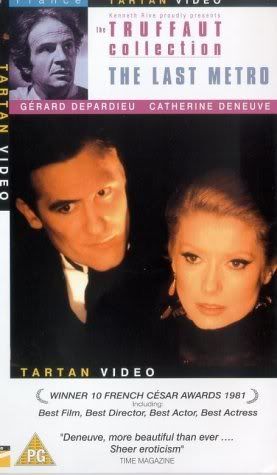
The Last Metro (Francois Truffaut, 1980)


Catherine Deneuve shines as conflicted wife Marion Steiner in this later-period Truffaut film about the Nazi occupation of Paris. Marion is married to Lucas, a Jewish theater owner who feels he has to flee when the Germans invade. Everyone thinks Lucas has fled, but only Marion knows that he is living in the basement of the theater, so he can still be with his wife and manage the theater. Marion is starring in the theater's current production and is handling all the business affairs of the theater, as well as making sure her husband's whereabouts remain secret. The leading man in the production, Bernard, played by Gerard Depardieu, is an active Nazi-resister and great actor, things that come to conflict in his life. The German censor, Daxiat, is also hovering around the production and is in love with Marion. All this personal drama is swirling in the background of the making of this play, making everyone's lives really stressful and pushed to the boiling point. Think of this movie as Day for Night, only more sober.

The acting is all superb, but the film's pacing leaves much to be desired, something Truffaut is usually brilliant at. The big twist near the end of the film was confusing, as the characters acted the complete opposite of the revelation the entire film. But that's undoubtedly what Truffaut was trying to portray; during this traumatic time in France's history, things are never what they seem, and people cling to what they have or can get in order to find happiness. Deneuve and Depardieu are dynamic together, and they bounce off of each other wonderfully, especially when they fight. One of Truffaut's last films, The Last Metro is a spectacular of style and acting, an exploration of one of France's darkest and least publicized periods in an unconventional way. The plight of the Steiners' theater company mirror those of France, but the end product is not always captivating.

7/10

RIYL: late period Truffaut

Labels: ,

StumbleUpon Toolbar Stumble It!

Wednesday, November 29, 2006

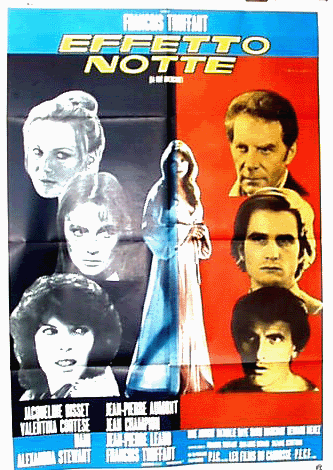
Day for Night (Francois Truffaut, 1973)


Day for Night is a kind of holy grail for people who love auteur theory and metafiction as much as I do (wow, that sounded pretentious). Francois Truffaut directs a film about making a film (May I Present Pamela, the kind of film that Truffaut, at this time, would have scoffed at, but doesn't present it as such) where Truffaut is the director Ferrand, starring, among others, Alphonse (played by Jean-Pierre Leaud, Truffaut's most important actor in real life - and one of my favorite actors ever - with the same name as Leaud's famous character Antoine Doinel's son). Wow. It makes my head spin a little thinking about it, but it flows so well in the movie. This film works just as well if you don't know anything about Truffaut's career, a pretty great feat onto itself.

But onto the plot of the film: Ferrand is making a big studio picture, with a washed up star (Severine), a closeted gay older actor (Alexandre), a young, very immature, star (Alphonse) who is in love with a script girl (Liliane, played by Dani, who also played Leaud's lover in Love on the Run), and a British/American actress (Julie) who has had several nervous breakdowns and recently married her much-older doctor. The movie is about the hardships and triumphs of making a movie, and on this production, nearly everything that could go wrong, does. It never feels unrealistic or silly, though; the problems are caused by the personalities of those making the movie. Truffaut is very interested in how important the cinema is, and the fact that film is more important than life to those involved. The movie is certainly more about personalities than a plot - the film itself is contained completely within the filming of the movie. The first shot, a huge crowd scene which is echoed near the end of the film, is gorgeous, and really conveys Truffaut's love of making movies, as well as watching them.

That love and joy is what makes this film so brilliant. All subtext aside, this is a portrait of a time in film that really can't be duplicated, where good directors (as Ferrand seems to be) were able to make huge, if not silly, pictures. Ferrand (speaking as Truffaut?!) himself says that Pamela is the end of an era, and now, instead of studio pictures, anyone can take a camera on the street and film. While that isn't really true, it is striking that Ferrand says that, because the French New Wave, of which Truffaut is a leading figure, was pretty much people taking cameras onto the street and shooting realism. This film is a simple, entertaining story, an in-joke, and a piece of metafiction all in one. This is my second favorite Truffaut picture (after Bed and Board), and a must for those who love film.

9/10

RIYL: Wes Anderson (he is clearly very influenced by this film, go carts and all), Godard

Labels: ,

StumbleUpon Toolbar Stumble It!

Wednesday, October 11, 2006

Love on the Run (Francois Truffaut, 1979)


I love Antoine Doinel. Really. I love him as if he was a real person, one that I know and have shared my life with. It's not as pathetic as it sounds, I hope, but watching Love on the Run was both a happy and sad experience on my part. It was another chapter in the Doinel saga, but it was the end. This movie is a strange ending to Doinel's story; it's part clip show of the series' greatest hits, part wrapup of Antoine's women troubles. The strangest thing about the movie is that, despite Truffaut's protestations to the contrary, it works. It's a fitting ending to one of the greatest series in film history.

When the film begins, Antoine (Jean-Pierre Leaud, without whom the Doinel films would not have been even half as good as they were, he truly was made for the part, not only because Truffaut wrote the films after 400 Blows for him) and Christine (Claude Jade, who is not in this film nearly enough) are getting a divorce, something that I really hoped would not happen, that some magical thing would happen to get those two back together. But it doesn't. Antoine is with Sabine (played by French children's television host Dorothee), and, as always, he is on the verge of cheating and losing her. Along the way, he reconnects with Colette, who he was in love with at twenty, who is now a lawyer and having a moral crisis over whether or not to defend a man accused of killing his stepson. Sabine and Colette's boyfriend may or may not be married/divorced (one of my major problems of the film is the lack of resolution in this subplot), and Antoine is writing a new novel, one based on the adorable story of how he came to be with Sabine.

There is no real plot, it is more of a character study of these three people (Antoine, Colette, and Sabine), and a realization of Antoine's women troubles throughout his life. The ending is artificially happy, and there's not nearly enough Christine in the film, but the experimental way in which Truffaut includes clips from all the previous Doinel films really works, even though Truffaut himself said it didn't. It's sort of like a clip show from your favorite series, but when it's something like Antoine Doinel's life adventures, you enjoy the trip back. A worthy entry in the series, although nothing like Stolen Kisses or Bed and Board. And it made me realize that I really need this, for both the films and the excellent Criterion special features (the best of any dvd set I've seen!).

8/10

Labels: ,

StumbleUpon Toolbar Stumble It!