Borderlands (Zev Berman, 2007): 6.5/10

The Magic Flute (Ingmar Bergman, 1975): 7/10

La Guerre Est Finie (Alain Resnais, 1966): 7/10

Speed Racer (The Wachowski Brothers, 2008): 8/10


My Photo
Name:
Location: milwaukee, wi

Tuesday, March 11, 2008

Raging Bull (Martin Scorcese, 1980)


Talking about Raging Bull at this point is kind of silly - I'm guessing everything that I want to say has been said thousands of times before and better. Two main points, though.

While I certainly liked the movie, I didn't love it. This is probably because of the intensely masculine nature of the film. I've never thought much of boxing in the first place, but Scorcese, the visual master that he is, really brought out the poetry and the beauty in it. I wish I had taken some stills of it, because it really is a gorgeous movie, especially the boxing scenes. The opening sequence, when DeNiro is hopping around the ring and the steam is rising from it, is one of the most beautifully photographed scenes I've ever seen. But the characters are, for the most part, so utterly unlikeable, and while that is never a problem for me liking a movie, it is their unsympathetic natures that really get me. LaMotta ends up a fat, pathetic slob, but it was by his own doing.

And strangely enough, the first/last scenes (with LaMotta at the mirror, practicing his terrible act) really impressed me with how great Paul Thomas Anderson is. I shot straight up and knew that this is where the final, infamous scene in Boogie Nights came from. The way Anderson reappropriates this scene (which was, ironically enough, reappropriated by Scorcese from On the Waterfront) is really a great statement on post-modern cinema. So Anderson is this generation's Scorcese, I say.

8/10

Labels: , ,

StumbleUpon Toolbar Stumble It!

Monday, December 18, 2006

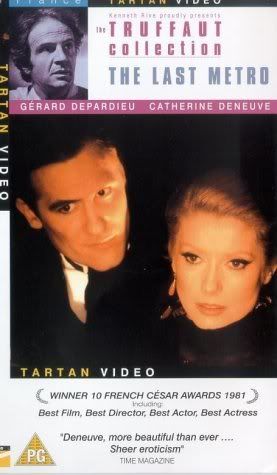
The Last Metro (Francois Truffaut, 1980)


Catherine Deneuve shines as conflicted wife Marion Steiner in this later-period Truffaut film about the Nazi occupation of Paris. Marion is married to Lucas, a Jewish theater owner who feels he has to flee when the Germans invade. Everyone thinks Lucas has fled, but only Marion knows that he is living in the basement of the theater, so he can still be with his wife and manage the theater. Marion is starring in the theater's current production and is handling all the business affairs of the theater, as well as making sure her husband's whereabouts remain secret. The leading man in the production, Bernard, played by Gerard Depardieu, is an active Nazi-resister and great actor, things that come to conflict in his life. The German censor, Daxiat, is also hovering around the production and is in love with Marion. All this personal drama is swirling in the background of the making of this play, making everyone's lives really stressful and pushed to the boiling point. Think of this movie as Day for Night, only more sober.

The acting is all superb, but the film's pacing leaves much to be desired, something Truffaut is usually brilliant at. The big twist near the end of the film was confusing, as the characters acted the complete opposite of the revelation the entire film. But that's undoubtedly what Truffaut was trying to portray; during this traumatic time in France's history, things are never what they seem, and people cling to what they have or can get in order to find happiness. Deneuve and Depardieu are dynamic together, and they bounce off of each other wonderfully, especially when they fight. One of Truffaut's last films, The Last Metro is a spectacular of style and acting, an exploration of one of France's darkest and least publicized periods in an unconventional way. The plight of the Steiners' theater company mirror those of France, but the end product is not always captivating.

7/10

RIYL: late period Truffaut

Labels: ,

StumbleUpon Toolbar Stumble It!

Thursday, October 05, 2006

Altered States (Ken Russell, 1980)


The concept behind Altered States is a thoroughly fascinating one: is there genetic memory in all of our bodies? How can we tap into it? The answers, in the movie at least, are yes, and through Mexican hallucinogenics and a sensory deprivation tank. While I'd like to believe the first is true, the second is a bit harder to swallow, and what makes Altered States an impressive try, but not very effective.

First off, the effects. I understand that they may have been impressive 26 years ago, but they really did not age well at all. The hallucinating montages are equally visually impressive/scary and cheesy, and the last scene is probably the epitome of 80s special effects. Even though I was getting into the message of the film, the effects brought me out of it a little. This isn't really the movie's fault (how could Ken Russell have known that it would look so corny in the future?), but it's still a disadvantage.

The feud between director Russell and screenwriter Paddy Chayefsky has been well reported. Chayefsky eventually demanded that his name be taken off of the credits because he felt that Russell destroyed the movie. I felt the exact opposite, that Russell's beautiful direction saved the film from Chayefsky's self-important, pseudo-science screenplay (adapted from his own novel). Russell is known for his lavish directorial style, and I think it really worked well here, in the story of trying to find Truth (if it exists) through hallucinations. William Hurt (in his first film role!) does a good job at portraying the obsessive, anti-emotional nature of Eddie Jessup, the scientist obsessed with finding out if out bodies have internal memories. Blair Brown, as his long-suffering wife, does a serviceable job, but is so beautiful, and Russell really shoots her in a marvelous way, especially during the hallucination scenes.

I was really enjoying the movie until the end. Without spoiling it completely for anyone who hasn't seen it, the ending (which is true of Chayefsky's novel, I have heard) is a true Hollywood ending, with all problems being resolved overly simply. It just does not work with these characters, especially Dr. Jessup, who has been so rational, almost bordering, ironically enough, into the irrational, the whole movie. Maybe Jessup did learn something profound in his last trip that changed everything he believed in his whole life, but I think it would have been more interesting for him to find out that not everything does end happily. A good watching experience that made me want to see more of Russell's films, but I just wish i could have seen it when it came out, to experience the "newness" of Russell's experiment.

6/10

Labels: ,

StumbleUpon Toolbar Stumble It!