Borderlands (Zev Berman, 2007): 6.5/10

The Magic Flute (Ingmar Bergman, 1975): 7/10

La Guerre Est Finie (Alain Resnais, 1966): 7/10

Speed Racer (The Wachowski Brothers, 2008): 8/10


My Photo
Name:
Location: milwaukee, wi

Tuesday, April 22, 2008

Two French films


As a recap of what I've been watching lately, I thought I'd demonstrate how wildly different contemporary French film can be. Regular Lovers, my first experience with director Phillipe Garrel, is a war story of a different kind. Set in 1968 Paris during the student uprising, Louis Garrel (the director's son, and one of my favorite French actors) plays Francois, a 20 year old poet who is, for the first hour of the film, involved with some revolutionary groups. We see stunning front-line footage, but nothing really ever happens. Garrel is trying to demystify what has become an epic myth about that time; his characters randomy flip cars over and have a hard time organizing anyone to do anything. As can be expected, the group's political efforts fall apart rather rapidly.

And yes, I did say the first hour. This film clocks in at nearly 3 hours, but the pace is so incredibly slow that it might seem like 6. There are long, unbroken shots of almost nothing happening, and while this can be beautiful under a trained eye like Garrel's, it's often frustrating as well. Francois falls in love with Lilie, a young, ambitious, beautiful sculptor, and the next two hours explore their relationship, as well as the lives of the tangential characters that share their lies, including more artists and a young man with a hefty inheritance and an opium addiction. Francois and Lilie's relationship isn't really tumultuous, although Francois does have problems with Lilie's insistance on non-monogamy( ones that he doesn't express, but you can see it in Garrel's expressive face). When they say they are going to be together forever, some people mean it more than others. The dramatic ending is a bit much, but mostly, the film is gorgeously shot and acted, if a little trying on the patience.

7/10


On the other side of the spectrum is Them, directed by The Eye's David Moreau and Xavier Palaud. A quick, not-even-80-minute horror film, the setup gets to the point, gets intense and scary, and stays that way. A French couple living in Romania (apparently because the boyfriend is working on a book), half an hour outside of Bucharest, is terrorized by a group of home invaders. That's it, although the story gets really scary. The girlfriend and boyfriend are more or less the only characters in the story, and while there's not much in the way of character development (but not in that way that shitty PG-13 horror movies put each character into a stereotype box), you honestly do care about the characters and do want them to get away. If you rent it, don't read the Netflix description, because, in that subtle Netflix way, it kind of gives away the ending. Nothing that will ruin the story, but still, come on!

I wasn't paying too much attention to the direction in The Eye, but where Regular Lovers is classically beautiful, Them is horror movie beautiful. Mostly taking place in the dark, there are some really scary moments, and the film is shot on grainy digital film, giving it a real documentary-type feel. If you want a quick, intense thrill ride, Them is for you.

8.5/10

Labels: , , , ,

StumbleUpon Toolbar Stumble It!

Thursday, April 10, 2008

Strange Circus (Sion Sono, 2005)


If the trailer for Tokyo Gore Police freaked you out, then Strange Circus certainly isn't for you. The movie begins as a story about a young girl who is forced into a sexual relationship with her father, until the entire family dissolves. In the meantime, she fantasizes about a circus atmosphere where she's accepted in her death.


Then the plot twists, and it's revealed that the first story is actually being written by popular Japanese author Mitsuko, who is flanked by syncophantic editors and one new guy, who seems un affected by her charms. From there, the movie takes you places you thought you'd never go, both plot-wise and visually. Although topics like child abuse (sexual and physical), murder, incest, self-mutilation, mutilation of others, disembowlement, and more, it's much more than it seems.


At its core, I believe Strange Circus is a film about the strange relationship that exists almost universally between mothers and daughters. Mitsuko, through narration, often equates herself with her mother, especially when she talks about how she's been waiting to be executed since she was born, or was she born on the executioner's slate. The relationship between Mitsuko and her mother is an eternally complicated one, including sexual jealousy and even abuse when the father begins sleeping with both females. Of course, most mothers and daughters never take their natural rivalry this far, but there are naturally twinges of competition in most relationships that close.


Sion Sono takes these existential themes and wraps them in a Japanese shock exterior. Many people who've seen it will say that Strange Circus is the most disturbing film they've ever seen, and I can't really argue with that. But much like other shock auteur Takashi Miike, this is shock with a purpose. If you can stomach it, Sono's Strange Circus is a shocking, thought-provoking watch. But it's definitely not for everyone, or even most.

8.5/10

Labels: ,

StumbleUpon Toolbar Stumble It!

Sunday, February 03, 2008

The Red Shoes (Yong-gyun Kim, 2005)


The Red Shoes' first impression is its confusing misnomer. The shoes are actually pink -- was this laziness on the translators' parts? Confusion? Is the Hans Christian Anderson story on which the movie is loosely based about red shoes, and could the filmmakers just not find any? In any case, these shoes appear in a specific subway station, and the woman who takes them is condemned to having those around them violently covet them. Of course, as happens in Asian horror movies, the shoes once belonged to a wronged ballerina who has come back in ghost form to haunt through these shoes for...some reason.

The first half of the movie is really great -- truly atmospheric, and Kim does a great job of directing. It's beautiful and creepy, like the best kind of ghost stories should be. But in the second half, and, in particular, the last half hour, the movie falls apart, as is the fate of so many horror movies. The plot suddenly takes so many twists and turns I wasn't quite sure what was going on, and even after the final twist was revealed, I was still like, "Huh?" And not in a good way. I think the movie should have kept the focus on the family dynamics, as the main character (Hye-su Kim) and her daughter Tae-su (Yeon-ah Park) have great, realistic chemistry, and scary children are usually really creepy (both as shown in the great Korean poster - the Tartan DVD art is good, but I prefer this image). But too much is made of the ghost/back story angle, even after it seems to be resolved. Worth seeing for the first half, but don't expect too much. How long before we see an American remake, I wonder?

7/10

Labels: ,

StumbleUpon Toolbar Stumble It!

Thursday, December 21, 2006

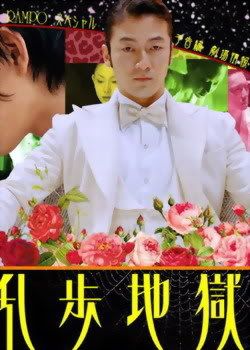
Rampo Noir (2005)


Rampo Noir is a counterpoint to 3 Extremes, both being collections of short horror films by Asian directors. While 3 Extremes had several high-profile directors (Miike, Chan-Wook Park), Rampo Noir collects shorts based on the short stories of Japanese mystery/horror master Rampo, from less well-known directors, two of whom are directing their first film on this collection. All four (all featuring actor Asano Tadanobu, whom I remembered from a few Tsukamoto films) are intensely creepy and beautiful, in their own perverse ways, but each are very different, so I'll quickly run down each one.

The first, Mars Canal, is less than five minutes long, and almost completely silent. It details the disintegration of a relationship, with a brutal fight, and then the man waking up in silence in a deserted (eerily beautiful) landscape. It's highly conceptual, and strangely engrossing. I was left wanting more after the only few minutes. The second, Mirror Hell, completely changes directions, and is a modern Japanese noir-esque detective tale. Several women connected with a traditional tea house are found burned, always with a certain traditional mirror found at the scene of their death. Tadanobu is the detective in charge of the investigation, and the answer is pretty mystical and surreal. The third, Caterpillar, directed by Hisayasu Sato (I have a few films of his coming up in the queue soon!) also features Tadanobu as a detective (the same one?) who is loosely connected to the case of a woman whose husband has returned from a war badly burned and without limbs. She starts torturing him in order to amuse herself, with confusing consequences. This was actually my least favorite of the four, but I'm looking forward to more of from Sato in the future.

My most favorite was from first-time director Atsushi Kaneko, and boasts the best directing and the absolute best performance from Tadanobu. It is the story of a seriously socially awkward chaffeur, who breaks out in hives when he touches other people, who works for a hot young stage actress. He falls in love with her, and when he goes to tell her, she ends up killing her. From there, his grasp on reality slips even further away, and the line between his fantasy land with the actress and the reality of her decaying corpse becomes seriously blurred. Tadanobu is great as the chauffeur; he is seriously crazy and yet a little sympathetic, because he understands reality so little. Tamaki Ogawa, as the actress, is not only a great performance, but is so ridiculously photogenic that she makes the whole film more beautiful (see here for some stills I made, probably my favorite stills I've ever done) and ethereal. The film is beautiful, creepy, and downright frightening, all at the same time. The cinematography is actually breath-taking, and I seriously can't wait to see more from Kaneko (Even though imdb doesn't show any projects from him coming up).

Most of the comments I've read call this collection pretentious, but if you like arthouse, more abstract horror mixed with extremely violent and visceral images, I highly recommend it. All four films are excellent, and, in some ways, I prefer this collection to 3 Extremes (which I also loved).

8.5/10

RIYL: Takashi Miike, 3 Extremes

Labels: , , , ,

StumbleUpon Toolbar Stumble It!

Thursday, December 07, 2006

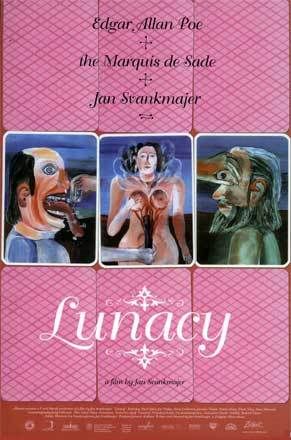
Lunacy (Jan Svankmajer, 2005)


Czech stop-motion animator Jan Svankmajer's new film is billed, at least on its IMDB page, as a horror film, and while there are some terrifying elements, I would call it more of a exploration of morality. At least, it's not a horror film in the traditional sense. A young man who has just lost his mother, who had been institutionalized, accepts a ride from a Marquis. Jean ends up staying at the Marquis' house for a few days, witnesses a bizarre religious ritual, and plays an unwilling part in the Marquis' therapy. Once Jean and the Marquis get to the local institution, and meet Dr. Murlloppe and his "daughter" Charlotte, all pretenses of normalcy are gone.

The scenes at the institution before the revolution (the less said about the plot, the better your viewing experience will be) are surreally wonderful: patients doing "art therapy" by painting a naked woman, feathers and chickens everywhere, and even a living reproduction of "Liberty Leading the People." When Dr. Coulmiere enters the movie, the real horror comes through, and as he explains the thirteen corporal punishments used to fix the mind, chills ran down my spine. The last ten minutes of the film, with treatment thirteen and Charlotte and Coulmiere's discussion, are truly terrifying, and speak to the depths of depravity possible in every human's soul.

Svankmajer's point can easily be simplified, as he does in his taped introduction to the film, to the fact that both extremes - complete liberty and complete control - can be equally bad, but add in Svankmajer's trademark animation present between each scene, that of pieces of meat and organs sliding around and doing human-esque things, add a layer of complexity and imagery to that moral. Maybe Svankmajer just wanted to make a scary, creepy film based on the writings of de Sade and Poe, but I think there's a lot underneath the surface. This is a movie that's horror stays with you, without much blood or creeps. I definitely recommend it, if you can find it.

8/10

RIYL: Little Otik

Labels: ,

StumbleUpon Toolbar Stumble It!

Friday, November 24, 2006

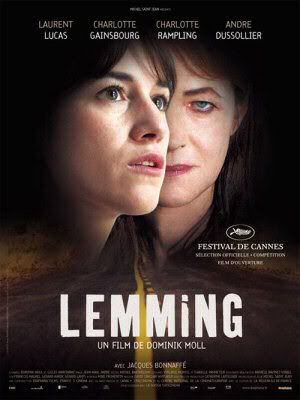
Lemming (Dominik Moll, 2005)


Lemming is the latest offering from Dominik Moll (With a Friend Like Harry), starring Laurent Lucas (whom I was impressed with in Calvaire) and Charlotte Gainsbourg (daughter of Serge and, most recently, costar of The Science of Sleep) as married couple Alain and Benedicte, pleasant enough yuppies who invite Alain's boss (Andre Dussolier) and wife (Charlotte Rampling, terrifying as ever) over to dinner one night. Mr. and Mrs. Pollock are hours late, and when they do arrive, Alice, the wife, is bitter and outwardly angry, not only at her husband, but also toward Benedicte, whom she calls pathetic. Nothing is ever the same for Alain and Benedicte after this visit, and especially after Alice calls on Benedicte a few days later. Not only is the Gettys' relationship changed and threatened, they have found a lemming in their drain pipe, an incredibly ominous sign for the rest of the film. What starts out as a drama about infidelity and what makes someone happy in modern day society turns into, in its second half, a ghost story about possession and the concept of reality. Unfortunately, these two good concepts are handled far too slowly and heavily to be of any real interest.

Gainsbourg is great as Benedicte, the mild-mannered wife who shows no real emotion until after the Gettys' visit. Rampling is barely on screen (only four scenes!), but her presence is felt throughout the entire film, the sign of a great actress. Too bad Moll didn't use her nearly enough here. Lucas turns in my favorite performance of the film, as Alain, who is torn between sexual desire and his absolute need for his wife. But when the elements all come together, as in Benedicte and Alain's trip to a mountainside cabin, the result is less then impressive. As several reviews I've read have said, the movie promises to be about that which is most intriguing and strange about existence, but in the end, is really about nothing. Psychological trauma has, unfortunately, never been so boring. Plus, the film, at over two hours long, could have been cut by at least half an hour and not really lost anything. I recommend this film for the performances, but not for the entirety, which tries to be a Lynchian interpretation of the suburban postmodern life, but fails.

6/10

RIYL: Merci Pour Le Chocolat, some elements of other Chabrol

Labels: ,

StumbleUpon Toolbar Stumble It!

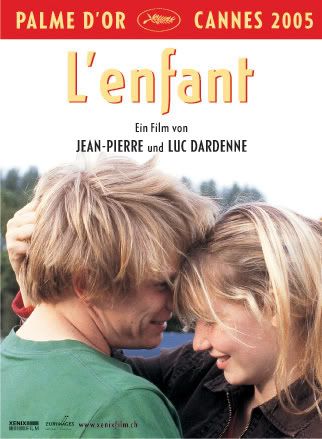
L'Enfant (Jean-Pierre & Luc Dardenne, 2005)


The brother team of Jean-Pierre and Luc Dardenne built upon their former successes (such as one previous Palme d'Or for The Son, which I still need to see) with another grand prize winner at the Cannes film festival, L'Enfant. Bruno is a young thug who presumably makes a very meager amount of money stealing and then selling items, as well as doing things like renting out his girlfriend Sonia's apartment for a few days. In fact, Sonia returns from the hospital after giving birth to their son Jimmy to find her apartment occupied by total strangers. Things just get worse for Sonia, who goes with Bruno to a homeless shelter, is left by him, and eventually is betrayed in a very shocking way - Bruno decides to sell Jimmy to an agency that does under the table adoptions. Sonia faints, goes to the hospital, and tells the police what Bruno has done; he, meanwhile, gets his son back, but gets into even greater trouble trying to make some more money so he (and his girlfriend and son, with whom he is not allowed to see) doesn't starve. The movie is Bruno's journey from childhood (it is pretty clear that he, and not Jimmy, is the child of the title) into real maturity, and understanding what it means to be a man, a lover, and a father. Whether or not by the end of the film he has completed, or even started, that journey is highly debatable, but the journey is an emotionally complex, wrenching one.

Jeremie Renier as Bruno is really stunning - the scene where Bruno nonchalantly tells Sonia what he's done, and does not understand her reaction (pointing to the money he got, he says, "This is for us. I thought we could just have another one"), is worth the price of admission alone. Deborah Francois as Sonia is very good as well - the Dardenne brothers do a very good job of showing how Sonia is not more than a child herself, as with her constant wrestling and play-fighting with Bruno. Even though most of the movie is sparse, with little dialogue and few visible emotions, there are also moments of almost perverse humor, like when Bruno pushes an empty baby carriage around the city. Comparable to Bresson in simultaneous emotional depth and shallowness, L'Enfant is a beautiful little slice of life, and although the Dardenne brothers are incredibly talented at letting this story come to a completely natural conclusion, it was too distant for me to care a great amount.

8/10

RIYL: Robert Bresson

Labels: , ,

StumbleUpon Toolbar Stumble It!

Sunday, November 05, 2006

Imprint (Takashi Miike, 2005)


This infamous, unaired episode of Showtime's Masters of Horror certainly is horrifying, but I also think it's an example of Takashi Miike - one of my favorite directors - at his most ridiculous. The story of an American journalist (a truly terrible performance by Billy Drago) who travels to Japan in order to marry the prostitute he promised he would come back for, only to find out that she's dead. Another prostitute, a woman with beautiful blue hair and a deformed face, tells him the story of how his beloved Komomo died, starting with a brutal but tolerable lie and moving to the horrific truth. The woman asks the journalist Christopher, before telling him the truth, why people want to know the truth so badly, why no one can ever been content with a more pleasant lie. This is the question Miike wants the audience to ask themselves after hearing the women's tale - wouldn't we have been happier with the lie?

The woman tell of working with Komomo, and, both because of her immense beauty and because she talked about her American lover, how she was tormented by the other women in the geisha house in which they both worked. The woman was Komomo's only friend, supposedly, and defended her from the attacks until one fateful day. The scene where Komomo is tortured is incredibly intense and painful to watch, even worse for me than anything from Audition or almost even Visitor Q. Unfortunately, the length and excess gore of the scene make it seem almost superfluous; the scene would have been more effective had we seen less, I believe. When the woman tells of her story, growing up with her abortionist mother and abusive father, the story becomes even more intense. There are plenty of fetuses deposited into the river, some of which are creepy, but others that are so fake looking to be silly.

The movie borders on silliness in its climax; without explicitly ruining it for those who haven't seen it (although there's no real twist ending, the twist comes more in the middle of the film), the special effect that goes to work on the woman's head is incredibly silly, so much so that I couldn't take it seriously. The movie is so intense as to be ridiculous at times, something I'd seen Miike work with before (such as in the superb Ichi the Killer), but always with a sense of humor that makes the ridiculous real. There is no humor in this movie, not even in the final scene, which is creepy, but again, a bit too much.

Before it sounds like I didn't like this movie, I must say that I do recommend it for fans of Miike or Masters of Horror, if only to see what was so controversial that Showtime refused to show it. It is pretty controversial, but almost for shock value at times. I can't really blame Miike for this, as he didn't write the script, but this is still a triumph for him if only because of how gorgeous and atmospheric it is. The prostitutes all have red hair and kimonos (except for the unnamed woman), and the scene where they are all sitting in the room together is heavenly in its use of color. The woman's blue hair is a radiant symbol throughout the film, and even during the silly parts, everything is so eerily beautiful.

6.5/10

RIYL: Audition

Labels: ,

StumbleUpon Toolbar Stumble It!

Monday, October 30, 2006

The Devil & Daniel Johnston (Jeff Feuerzeig, 2005)


Daniel Johnston is a living indie legend, praised by everyone from Sonic Youth to Kurt Cobain to Jad Fair and is legendary in the indie singer-songwriter genre. In fact, it seems that modern freak folk founds its roots in Johnston's off-tune guitar playing and simple lyrics. But Daniel Johnston is seriously mentally ill, and the music that many found so inspiring was really an airing of the (literal) demons found inside him. Jeff Feuerzeig's documentary is in some ways an enlightening portrait of this sick artist, and in some ways a frustrating continuation of the legend that is Johnston, who today lives with his parents because he cannot take care of himself.

Through lots of interesting archival footage and interviews with those who knew him, a portrait of Johnston appears - at first, an artist making something new and unheard in the Austin scene of the mid-80s, and then more and more, a man obsessed with casting out the devil and seeing the devil following him at every turn. Johnston visits Sonic Youth's Steve Shelley in New York City, gets a recording session with Moe Tucker, drummer from the Velvet Underground, and yet still ruins the best opportunity of his life because he is too mentally ill to deal with it. As someone in the movie says, whenever things start getting good for Daniel, his illness (made worse by his refusal, often, to take his medication) ruins it all. It is frustrating for someone like me, who has experience with mental illness, to see people idolizing this man's demons. But again, like a friend of Johnston's says in the film, in history, people who prioritized mental health over genius are seen as philistines who don't understand the artistic mind; how can we say Johnston should get help over creating his music?

An interesting portrait of a very interesting man, but with a few problems. I would have definitely loved to see more interviews with Johnston himself; although Feuerzeig had access to Daniel, there are precious few moments of Daniel currently talking in the film. This adds to the legend of Daniel Johnston, and it's up to the individual to decide if that's a good or a damaging thing.

6.5/10

Labels: ,

StumbleUpon Toolbar Stumble It!

Thursday, October 26, 2006

MIFF: Best in Show short program

The selection committee of the Milwaukee International Film Festival saw 1400 short films and made a best in show program out of the ten they liked best. All were solid, some much better than others, and here are my two favorites.


My Dad is 100 Years Old (Guy Maddin, 2005)

I am a Guy Maddin devotee, I absolutely love all his work that I have seen. So I was very excited to see his latest movie, a collaboration with (and written by) Isabella Rossellini about her father, Roberto, who would have been 100 years old this year. In it, Isabella discusses the politics of her father's films, not the films themselves, but the neo-realist form that they announced to the world. She (pretty brilliantly) plays Hitchcock, Selznick, Fellini, and an angelic Chaplin, along with her mother, Ingrid Bergman, in a scene that was so incredibly moving. Rossellini talks to her mother's image, projected onto a screen 10 times as tall as Rossellini, as if talking to her mother's public persona. Roberto Rossellini is portrayed by a big belly, as Isabella said in the beginning of the film that that was the part of her father she loved most as a child. As both a love letter to her father (she describes how devastated she was when he died in 1977) and an essay on his films, it is incredibly well-written and beautiful, especially as rendered in the Maddin style. A very funny moment in the film (16 minutes long) came when Maddin pulls the camera away from Rossellini, into the sky, and Isabella commands him to pull it back, focus on her face, and stop those cinematic techniques her dad found so pretentious. All of this is lovely, but it is Isabella's last monologue, where she says, "I don't know if my dad was a genius. I do know I love him," that made me tear up. Very worth seeing.
8/10


Five Minutes, Mr. Welles (Vincent D'Onofrio, 2005)

No film has had such an immediate, visceral effect on me recently as Vincent D'Onofrio's directorial debut, Five Minutes, Mr. Welles. I remembered how much I liked D'Onofrio's brief turn as Welles in Ed Wood, and Welles is one of my top directors of all time (with The Third Man probably in my top 20 films oat), so I was very excited to see this. I was definitely not disappointed. D'Onofrio plays a frustrated Welles, rehearsing his lines as Harry Lime, even though it's a part he only took to finance his production of Othello. Janine Theriault plays Catherine, his assistant whose job it is to keep him on track, an increasingly difficult one as, in one hilarious instance, Welles attempts to jump out the window when called to the set. Catherine won't lie to the studio for him, Welles is frustrated with his lines and wants to write more/new ones, even though he can't remember the ones he already has. D'Onofrio coyly refers to Welles' future eating problems, as when he gets particularly upset, he pulls out the pistachio ice cream. But apart from being a genuinely entertaining little movie about a great artist in crisis, it really speaks to the nature of trying to be an artist in the Hollywood system and of integrity versus the need for money. After seeing this, I had a greater respect for Welles, even though his behavior is downright childish at times, and after researching him a little when getting home, found the amount of things Welles, a self-described genius, had to go through to make moves he wanted to. As Catherine tells him in the film, he started from the very top and worked his way down. Welles tries to argue that what Citizen Kane lost in revenue, it gained in something much more important, but no one in the studio system was buying this at that time. The scene where Welles has a tantrum and falls on the ground and finally remembers his line (showing how brilliant he really is when he puts his mind to it), is in my top ten film moments of all time.

After seeing this film, it made me really want to go home and write something, and also to reevaluate Welles' films in the context of a frustrated artist. A really entertaining, great portrayal of a great, great filmmaker.

9/10

Other good shorts included The Shovel (a brisk, taut thriller starring David Straitharn) and Bawke, a tragic tale of a refugee man and his young son.

Labels: , , ,

StumbleUpon Toolbar Stumble It!

Wednesday, October 25, 2006

MIFF: 13 Tzameti (Gela Babluani, 2005)


13 Tzameti was, along with Wristcutters: A Love Story (which I'm probably not going to be able to see after all, boo), one of the films that I was most excited about seeing at MIFF this year. As with many thing I've highly anticipated, I was a bit disappointed by the empty and rather predictable story. A young (hot!) carpenter named Sebastien is employed to work on a couple's roof; when the man dies, the wife refuses to pay Sebastien, and he takes an envelope containing a train ticket and hotel reservation as if in retribution. Little does he know that he has taken an invitation to a secretive competition where rich men bet on the lives of 13 competitors. Sebastien is the titular 13.

Basically nothing happens in the first half of the movie, and when Sebastien gets to the competition...more nothing happens. The movie is very, very tense, but the violence does not escalate like a good thriller should. The competition is the same, only for several rounds; for me, after the first round, the shock factor was gone. I commented in my head that it's like an artsy version of Hostel, with rich people buying the lives and deaths of others, only without the violence or terror. The black and white gives it an atmospheric touch, and the cinematography is beautiful, but I was not that impressed by the action of the film. The film's defenders would say that it is a trip into the sadism of modern life, and the depravity of the human soul; I would ask where those things are! Aside from the violence, there is no characterization of the betting men or even of the other competitors (except a little of Sebastien's main competitor). They are faceless people, which makes the terror unfamiliar and dull. Even Hostel gaves faces to its murderers! The tipping point for me, however, was the events after the competitions, which are predictable and made just to upset the audience.

As a debut film, Babluani's direction and script are good, but this film is so problematic that I really can't recommend it. If you're not desensitized to violence (like I think I am), however, you might find this shocking, as many in the packed audience I was in gasped several times. I, however, was not that interested.

5.5/10

Labels: , ,

StumbleUpon Toolbar Stumble It!

Saturday, October 21, 2006

Twelve and Holding (Michael Cuesta, 2005)


I was expecting good things from Twelve and Holding, as Michael Cuesta's debut, L.I.E. was an interesting, fearless portrayal of pedophilia. I was hoping for the same daring intellectual approach to children's lives in the twilight of young adulthood. Instead, I got a Hollywoodized, stereotypical view of all these children's lives, one that does not allow the audience to get to know and empathize with them.

The film revolves around Rudy Carges' (accidental) death by fire by two local bullies. His twin brother Jacob (who has a birthmark covering half of his face, and is obviously the quieter one of the twins), and friends Leonard and Malee are left to deal with the tragedy. Actually, Jacob is the only one who really deals with it directly; he becomes obsessed with getting revenge on the boys who killed his brother, visiting them in prison to tell them what he's going to do to them when they get out. As Jacob, Conor Donovan is convincingly paradoxical in his emotions, as he seemingly starts to forgive the imprisoned boys, yet still hates them and his family as well. I would have appreciated a lot more insight into Jacob's motivations, his life with Rudy as well as without.

The two problematic and stereotypical characters are Leonard, a fat kid who wants to lose weight, and Malee, a sexually precocious Asian preteen. I'll probably reveal more than you might want to know plot-wise in my discussions of these two kids, so if you want to remain spoiler-free, stop here! Leonard is so out of shape that the high school football coach tells him that if he can get into some sort of shape, he'll be on the team next year. A touching gesture, but Leonard becomes obsessed with weight. Here comes my problems with this. Obviously, we are supposed to see Leonard's obsessive weight loss as a good thing, but Leonard starts to look down and hate his fat family because they're fat, and again, the audience, I think, is supposed to agree with him. Leonard's family is hardly ever (perhaps never) shown doing anything except eating, as if that's all fat people do. Leonard hates his fat and his family, and we are supposed to as well. Even after Leonard almost accidentally kills himself and his mother (long, somewhat silly plotline), his mother forgives him immediately and agrees to lose weight. Leonard's plotline is disappointingly fatphobic, when it could have been an intelligent discussion on the nature of family and self-image. I was disgusted.

Malee deals with Rudy's death by becoming obsessed with a patient of her mother-psychiatrist's. It's touching and very sad that Malee believes that Gus might love her, despite him being in his early 30s and she being 12. I was touched by her blooming love for this man, because I remember what it was like to be on the verge of womanhood and thinking that I was a real woman now. But, like Leonard's story, Malee's takes a disappointingly stereotypical turn. Malee sneaks into Gus's house one night, makes him dinner, cleans his house, and puts on a kimono and puts her hair up in order to make him happy. One on hand, it's intentionally sad because that's what Malee believes a man wants from a woman, but on the unintentional side, Malee becomes eroticized by being the "other," the Asian geisha-girl of men's dreams. Malee, being an Asian woman, obviously, to Cuesta at least, cannot express her sexuality in a way other than this eroticized other. It was sickening to my feminist, women's studies concentrator self, to see this little girl forced into the stereotypes of Asian sexuality. I think that this is unintentional, and not Cuesta's point.

All in all, a somewhat infuriating, definitely frustrating movie with an ending I saw coming a mile away. A definite step down for Cuesta, whom I hope can regain his indie consciousness and ear for reality in his next film.

5/10

Labels: ,

StumbleUpon Toolbar Stumble It!

Friday, September 29, 2006

Three Times (Hou Hsiao-hsien, 2005)


I had heard so much about the profundity and ambience of Hsiao-hsien's film before seeing it that I was a little intimidated by it. Maybe intimidated isn't the right word, but it seemed bigger than life. After watching it, however, Three Times, while profound, isn't about anything bigger than life, but about life itself and the love therein.

Three Times is divided into three segments, one around the turn of the 20th century, one in the 1960s, and one in present day. Qi Shu and Chen Chang play the lovers in each section, giving the entire film a timeless quality. The first segment, set in the 1960s, is about a soldier and a pool hall attendant who seem ill-fated. This one was by far my favorite, as the atmosphere (settings, costumes, all that) and music were absolutely perfect, and really set the scene for these lovers' missed connection. The acting, as in all section, is perfect, yet with very little dialogue. The body language and facial expressions of the two leads speaks volumes more than anything they ever could have said.

The second section, set in the early 1900s, is literally silent - the dialogue is presented written on screen as in silent films. At first, I was annoyed by this seemingly "cute" tactic, but as the tale of impossible love continued, it again put the focus on the characters themselves, and not what they choose to say to one another. The third story, set in present-day Taipei, deals with a disturbed, bisexual eplipetic and her affair with a man behind her girlfriend's back. If the first section's ending had the audience expecting marginally happy endings of these tales, the other two smash those perceptions. Three Times shows the tragic and inevitable nature of love; you cannot control your heart, the overriding theme seems to be. A great, beautiful movie (although I have to admit that it made me more than a little excited for Aronofsky's The Fountain, which has more or less the same premise).

8/10

Labels: ,

StumbleUpon Toolbar Stumble It!

Tuesday, September 26, 2006

Dance of the Dead (Tobe Hooper, 2005)


I'm not a big Tobe Hooper fan. To be honest, I prefer the 2003 Texas Chainsaw Massacre remake to the original. Horror fan sin, I know, but the original is sort of boring. Anyway, I wasn't expecting that much from Hooper's Masters of Horror episode Dance of the Dead, and I was right. The hour-long show at the same time feels like ten minutes and three hours, as nothing really happens.

Based on a short story by Richard Matheson (who wrote the teleplay), Dance tells of a post-apocalyptic United States, mostly represented by a club who's main attraction is, well, the dance of the dead. Robert Englund does a great job being appropriately creepy as the club's MC, but the dance of the dead itself is obscured by camera angles, and not particularly impressive. The camera tricks are my main problem with this episode in general; it's like someone just realized all these cool things their camera could do, but instead, it's incredibly distracting and pointless. The scene with the four kids in the car goes on way longer than it needs to, and is so visually overwrought that it's hard to watch. Alongside the overdone effects, the plot is paper-thin, so much so that I won't even go into it here, for fear of "spoiling" something. Nothing really happens, and when it does, you can see it coming a mile away. I'm a Masters of Horror completist, but I wouldn't recommend Dance of the Dead for anyone except the other completists in the world.

4/10

Labels: ,

StumbleUpon Toolbar Stumble It!

Tuesday, September 19, 2006

Jenifer (Dario Argento, 2005)


For his episode of Showtime's brilliant (in concept, not always in execution) series Masters of Horror, Dario Argento takes a teleplay written by Steven Weber, who also stars, about a deformed girl named Jenifer who has strange powers over men. Jenifer's face is rather horrifying, especially the first time you see it, and she is unable to talk and often acts like an angry cat. Weber plays a police officer who saves her from being murdered, then falls victim to her powers (even after she does things like eat his cat).

And that's pretty much it. The gore, of which there is a pretty good amount, is realistic looking, but there aren't really any actual scares. Nor does the audience ever find out any more about Jenifer than what she does in the present. I was dying to know how she got deformed, where these powers come from, and even if she was human or not, but the audience never gets that much. It's all surface here, which is entertaining enough, but not enough to make it one of the better MOH episodes I've seen. Speaking of which, Takashi Miike's banned Imprint comes out on DVD September 26th, and I haven't been this excited to see a movie since...I don't know. I'm just psyched. So, unless you're a die-hard horror/Argento fan (which I am), you might want to pass on Jenifer.

6/10

Labels: ,

StumbleUpon Toolbar Stumble It!

Tuesday, September 12, 2006

Boys of Baraka (Heidi Ewing & Rachel Grady, 2005)


One last update before I head to Minnesota until Sunday - no updates until Monday at the earliest. But I did manage to catch Boys of Baraka, a movie I had been very excited to see, on PBS tonight. This is really a remarkable documetary, one that moves you into many different emotions and speaks to the power people have to help others.

The Baraka school in Kenya takes 12 middle-school aged boys from Baltimore and enrolls them for two school years. They do both academic work and work that teaches them discipline, respect, and other qualities that these boys need to stay out of jail and have a successful life. The progress of these boys, four of which are profiled in-depth in the movie, is at first rocky at best. But through the progress of the film, these boys learn some important things about life and their places in it.

The boys who are profiled in the movie are your stereotypical cires for help; none have fathers present, they get in trouble at school, and have trouble academically. My heart went out to Richard, who, as a 13 year-old boy, has a reading level of a second grader. No teacher has ever taken the time enough to even realize Richard's apparent learning disability, much less help him. Although I'm a stauch believer (and attender) of public schools, there's a difference between teachers who care, and those who don't. Without getting any further into urban politics, the school system, along with basically everyone in their lives, has failed these boys, and the Baraka School tries to repair some of that damage.

Without giving away what happens to these students, the movie moves into both inspiration and devastation in its final minutes. This is what a documentary is supposed to me; moving and truthful, and reveals something about life.

9/10

Labels: , ,

StumbleUpon Toolbar Stumble It!