Borderlands (Zev Berman, 2007): 6.5/10

The Magic Flute (Ingmar Bergman, 1975): 7/10

La Guerre Est Finie (Alain Resnais, 1966): 7/10

Speed Racer (The Wachowski Brothers, 2008): 8/10


My Photo
Name:
Location: milwaukee, wi

Friday, March 28, 2008

Another Day In Paradise (Larry Clark, 1997)


Larry Clark is really a love or hate director for most people. I personally love him, a lot. When I worked at a university library one summer in special collections, I would hide in the air conditioned rare books basement and read dirty books; particularly, old issues of Playgirl, High Times, and Larry Clark photography. I love the maligned Ken Park -- it's a film with no real plot to speak of, but short vignettes about how hard it is to be a teenager. That's what most of Clark's films are about, the in-between period when you're not an adult, but certainly not a child, and what sex and love and fun means to you then. In Another Day In Paradise, Clark takes on adulthood, or at least two adults who are in a state of arrested development, and two young people who want to be adults. James Woods and Melanie Griffith (with whom I was surprisingly impressed) play Mel and Sid, two junkie thieves who end up hooking up with Bobbie and Rosie (played by Vincent Kartheiser and Natasha Gregson Wagner, who both give wonderful performances but seem to have fallen victim to the strange young actors of the 90s curse), two teenage junkie hoods who want to become big time. Mel and Sid become like parents to Bobbie and Rosie, but, like most things, the good times only last so long.

The plot isn't so much what's important about Another Day In Paradise; rather, it's the movie one can point to when detractors try to claim that Clark isn't a director, but instead is an exploiter of underage sexuality. This film has lots of beautiful and occasionally poignant moments. All four of the leads are remarkably well acted, and in all these people at the bottom of society, we see glimpses of failed dreams and vulnerability. But it wouldn't be a Clark film without some sex, and although this was the director's cut, there was some of the most straightforward sex talk I've seen in film in a while. Wagner in particular is fantastic as Rosie, who wants to be rich and have her fun like with Bobbie, but also wants to settle down and be a mother (hard with a heroin addiction), but fails in the end. The only real problems I had with the movie is that there was no way that Wagner plays for a teenager, as she was almost 30 at the time of filming; and I could see where the plot was going long before it got there. But like I said, plot isn't the most important thing in this film, but rather the actors' reactions to the situations. Those are all amazing. Not Clark's best film, but certainly a really good one, no matter who the director.


8.5/10

Labels: ,

StumbleUpon Toolbar Stumble It!

Monday, January 28, 2008

Rainy Dog (Takashi Miike, 1997)


I don't have too much to say about Rainy Dog - Takashi Miike is one of my favorite filmmakers, and this, his experiment in noir, is hit and miss. It's marginally confusing in places, and devoid of almost any dialogue; as a matter of fact, one of the main characters is a mute child, and another is a prostitute who lies about herself on the internet. Miike does an admirable job stripping away the layers of these people, and revealing them for who they really are, or, at least, who they really want to be.

I wanted to blog about this film, because I found in it yet another scene "homaged" in Kill Bill. In the last scene (spoiler!), when the brother-in-law kills Yuji, and Ah Chen looks on, he tells the child that when he grows up, if he's still mad, he should come and kill him. Ding ding ding! Sounds like the exact same thing the Bride tells Vernita's daughter in the first volume. When I first saw Kill Bill, I was amazed at its ingenuity; four (right?) years later, after I've seen a lot more exploitation and Asian films, I realize that Tarantino really co-opts a lot of shit. More than any filmmaker should without acknowledging it. So while I appreciate Tarantino still, I think more people should be aware of that. Hey, just watch the originals that he stole his ideas from instead!

But back to Rainy Dog: 6.5/10

Labels: , ,

StumbleUpon Toolbar Stumble It!

Tuesday, November 20, 2007

Who the Hell Is Juliette? (Carlos Marcovich, 1997)


Who the Hell is Juliette? is one of the most entertaining, beautiful, poetic documentaries I've ever seen. And the funny thing is, I'm not even sure how truthful it is. But unlike Zoo, which also mixed drama with documentary, Carlos Marcovich's docudrama never felt as if it was missing pieces, or covering up the unsavory bits of life with its drama. To the contrary, actually. Juliet (or Yuliet in Spanish, as she insists in the first shot - the first introduction we get to Juliet shows her as sassy, yet knowledgeable about who she is and what she wants, an impression that lasts throughout the film) is a 16-year-old girl living in Havana, who director Marcovich met on the set of a Mexican music video (I think - although Marcovich involves himself in the plot somewhat, the origin of his interest is still relatively unknown) and who enchanted him. It's not hard to see why Marcovich became fascinated with Juliet; although she's had a hard-scrabble life - her father abandoned her family before Juliet could even make any memories of him, her mother, soon after, killed herself by burning herself alive, and she on occasion makes money by whoring herself out to tourists for $1 - Juliet is witty, snappy, and full of life. She's completely endearing, even when she's talking about her baby cousin's hard-on.

The loose narrative in the film centers around Juliet and Fabiola, a gorgeous Mexican model who Juliet worked with on said music video. Juliet was found on the street and hired because she looked so much like Fabiola, and in the video, the two play sisters. From that time on, they developed a sisterly bond that, even though we don't see much interaction between the two girls during the film, is clearly very strong, stronger even than most blood ties both girls have. Fabiola might seem to have a much better life than Juliet; she travels to New York City for modelling jobs, and seems to have a very glamourous life. But Marcovich, through the first-personal confessional-esque shots of both girls, reveals some deeper similarities, most importantly that both were abandoned by their fathers and have issues with men.

As interesting as the story of these two girls' lives are (Juliet's story gets about 70% of the screen time, Fabiola's, 30%), Marcovich inserts fiction randomly into the movie. In fact, I'm not even sure how much of this is real, or how much is fake. From Havanese Marcovich inserts saying other people's lines (most memorably, a young boy who introduces himself at the beginning as the one we should come to when we are unsure of something) to breaking the fourth wall and showing the boom mic operator, keeping in the times when the subjects talk to him, and even one scene where he seems to be telling Fabiola what to say in the middle of a very personal speech about her sexuality versus Juliet's. There are scenes where Juliette is on the phone, purportedly with her father, but we never see who is on the other end. Who is she talking to? Is it anyone at all? But instead of enraging me, these decisions thoroughly intrigued me. What is the difference between fact and fiction in our lives? If we say something is true, what makes it untrue? Juliet's constant "confusing" of the words actual (real) and actuar (to perform) is incredibly clever and thought-provoking.

Maybe what I've written about the film has you scratching your head. Who the Hell is Juliette? had me scratching mine, but in the best possible way. Not only is it a compelling story and a interesting meditation on fact and fiction, it has several of the most genuinely moving scenes I can remember. When Juliette tells the modeling agency that she wants fame and fortune, only in Havana and not Mexico City, it's a matter-of-fact statement on the importance of having a home, one that particularly struck me. And I won't even start on the scene when Juliette and her father finally meet face-to-face. The only thing that disappointed me about the new Facets DVD is the "10 Years Later" featurette - only a few words from Juliette and none from Fabiola, it's mostly a vanity piece on Marcovich's part. So maybe he's right when he says that second parts are never any good. I recommend this film as whole-heartedly as I have any film on this blog.

9/10

Labels: ,

StumbleUpon Toolbar Stumble It!

Monday, November 27, 2006

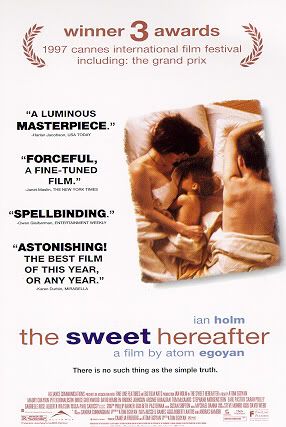
The Sweet Hereafter (Atom Egoyan, 1997)


The next film in my new Egoyan obsession was The Sweet Hereafter, which is probably Egoyan's most well known and acclaimed film. It's the story of a small town, devastated by a school bus crash that killed most of the town's children, and the big city lawyer with his own problems who comes in to get the victims lined up for a class-action suit. The plot sounds typical, but the characters are anything but. The townspeople are not just grieving small-town yokels, and neither is Mr. Stephens, the lawyer, a slick big-city guy looking to take these people for all the money they can. Everyone has their own ways of grieving, from sex, to anger, to the bus driver's extreme contrition yet unfailing optimism. Stephens has a daughter, Zoe, whom he loves so much, yet who despises him and is in an unending downward spiral. Billy, played by Bruce Greenwood, tries to convince his fellow townspeople to dismiss the lawsuit against the bus manufacturer. Nicole, Sarah Polley in a solid performance, is a survivor of the crash who is now paralyzed, and holds the whole lawsuit's fate in her hands. There is also a subtle incest subplot, which plays a huge part in the movie's ending. Egoyan portrays these people as just like any others, with huge secrets and hidden sides.

The performances are all very real, and the scene where Billy sees the bus with his children on it spin down the icy hill to the children's deaths is one of the most tragic I have seen on film. Another amazingly powerful scene is when Stephens recounts the story of when his daughter almost died as a baby, when he held her life in his hands, literally. These two centerpiece scenes evoke the tragic nature of everyday life. Most of the film is so understated, however, that the tragedy is almost muted. The realism goes further than my emotions can follow, I suppose. So while I definitely liked this film a lot, it didn't reach the heights I thought Exotica did.

7.5/10

RIYL: The Ice Storm

Labels: ,

StumbleUpon Toolbar Stumble It!

Thursday, October 19, 2006

Funny Games (Michael Haneke, 1997)


I was really excited to see this film. I'm a fan of films that are disturbing in a philosophical way (and in a horror movie way, but that's another post), and this seemed to be along the same lines as something like Gaspar Noe's Irreversible, a film I really like. Was I wrong. Wrong, wrong, wrong. Funny Games is, strangely enough, both immorally violent and seriously boring. The postmodern devices Haneke uses to make this film a critique of modern society (I think) are just precious and incredibly annoying.

Two young men, Paul and Peter, although they refer to themselves as various pop cultures names, come innocently enough to a couple and son's vacation house to borrow some eggs, and end up sadistically torturing them, physically and mentally. The first 20 minutes are promising, with a sense of tension and dread throughout every action. But once the "games" begin, the action is entirely predictable and often boring. I'll give you just a few of my problems with the film: for the first 45 minutes or so, there are plenty of opportunities for the family to escape. They are being held hostage by two men with a GOLF CLUB. That's right. I felt that there were several obvious spots where any person with any sense would have tried to escape (like when Anna went into the kitchen, without any supervision, to get Georg an aspirin). It's not like a horror film situation, where the characters are just stupid or panicking, it's just a lack of realism (to the end of hyper-realism??) on Haneke's part. The violence was predictable, and the devices that Haneke uses to achieve postmodern status, such as breaking the fourth wall and having the characters talk to the audience, as well as other things that I won't spoil here, seem very forced and unenlightening.

The ending is a total lack of resolution and any sense of the future, and while I know that's what Haneke was probably intending, that doesn't make it any more well done or less frustrating. This review is probably pretty poorly written, but I haven't been this disappointed in a film in a long, long while. Such a promising premise, such a pretentious product. I haven't liked anything I've seen by Haneke so far, and I don't think I'll be giving him another chance, at least for a little while.

3/10

Labels: ,

StumbleUpon Toolbar Stumble It!

Friday, October 13, 2006

Cube (Vincenzo Natali, 1997)

a


Cube is another movie that sat in my room from Netflix for about two weeks before I watched it. Not a good sign, but I ended up enjoying it well enough. Although the acting and dialogue are sub-par at best, the intriguing and complicated idea of the film make it worth a viewing. I don't have too much more to say about the film than that. The acting is amateur at best, it's obvious that these people are first-time actors (at least, I hope so), and most of their performances remind me of high school theater, with their emotions played up to the fullest and most obvious way they could have been. The one exception was David Hewlett, who played Worth, the nihilistic architect. He was angry, sullen, and seemingly indifferent in ways that made the audience question his motives. The dialogue has the same problem, amateur-ness, and is often ridiculous, even laugh-worthy.

Despite these definite flaws, Cube is like an episode of The Twilight Zone brought into the 21st century, with all the paranoia and isolation that goes along with living in the new century. The cube structure that these random strangers is a nightmarish place, filled with weapons and fear that have been building in these people their whole lives from living in this modern world. There are some cool violence effects, especially at the very beginning, when a man literally gets cubed. The film goes on a little longer than it needs to, but it's an interesting thought experiment that gets clouded up by bad acting and dialogue.

6/10

RIYL: The Twlight Zone, Saw (which seems to have lifted its premise from Cube and added more gore)

Labels: ,

StumbleUpon Toolbar Stumble It!