Borderlands (Zev Berman, 2007): 6.5/10

The Magic Flute (Ingmar Bergman, 1975): 7/10

La Guerre Est Finie (Alain Resnais, 1966): 7/10

Speed Racer (The Wachowski Brothers, 2008): 8/10


My Photo
Name:
Location: milwaukee, wi

Wednesday, November 22, 2006

Angels and Insects (Philip Haas, 1995)
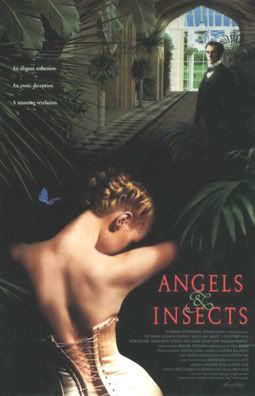


Angels & Insects is the best Peter Greenaway film Greenaway himself never made. The story of undlying sexual and emotional pathology in Victorian England, the plot (adapted from a novella by AS Byatt) and imagery reminded me so much of Greenaway's signature style that I had to remind myself several times that it wasn't him. It is the story of William Adamson (Mark Rylance, who was the bright spot for me in Institute Benjamenta and is equally brilliant here), an etymologist who lost all his Amazonian specimens in a shipwreck, now housed by the Alabaster family. He ends up marrying the older daughter Eugenia (a radiant Patsy Kensit), making an enemy of the son Edgar, and becoming great friends and intellectual partners with the younger daughters' tutor, Matty Crompton. As he becomes more and more entrenched in the family, their internal politics and quirks (to put it lightly) are revealed, leading to devastating consequences.

William is obsessed with insects, and the Alabaster family is a life-size version of an ant colony, a parallel that is made several times throughout the movie. The Alabasters are no less primal nor complicated than these instinctual creatures. Even though I had known the big twist, when it is revealed, it is no less chilling and distressing than if I hadn't known it at all. Rylance is pitch-perfect in his role as a genuinely good guy who really does come to care for Eugenia and is terribly betrayed. Kristin Scott Thomas as Matty, the voice of sanity in this insular household, is well-suited for her role and performs it pretty well. The imagery of insects pervades the film, and is very much reminiscent of A Zed & Two Noughts' obsession with decay. This Victorian culture is decaying, and modernity is creeping in when the Alabasters had their back turned. They try to hold it back, but it's inevitable.

8/10

RIYL: Peter Greenaway (it's a real mixture of The Draughtsman's Contract and A Zed and Two Noughts)

Labels: ,

StumbleUpon Toolbar Stumble It!

Thursday, November 02, 2006

Safe (Todd Haynes, 1995)


Safe is a hard film to talk about, because it's so glacially paced and internal. Carol White, played understatedly and wonderfully by Julianne Moore, is a typical 80s affluent housewife, with a southern California mansion, a rich husband, and no job. She fills her days with things like lunches with friends, aerobics, and picking out the absolute perfect couch for her home. She is disturbingly blank, with no real personality, just a desperate need to please everyone around her. Things go (even more) terribly wrong, though, when Carol starts getting sick, headaches, nausea, and panic attacks, with no apparent physical cause. Carol attends a seminar on "environmental illness" on a whim, becomes convinced that it's what is making her so sick, and eventually gets so bad that she needs to move out to a community of the environmentally ill in the New Mexican desert.

Much of the social critique in Safe is too obvious for me to really appreciate. It's pretty obvious, for example, that Carol's vacuous life is probably the thing that's caused her illness; her psyche has started revolting against the utterly empty, material life she has been living, so much so that she has to move out of modern culture entirely and back to a more primitive, basic way of life. The interesting thing about Carol's illness, though, is that she gets worse as she goes to the treatment center, forcing her to eventually isolate herself completely (even as the prospect of a new, meaningful relationship reveals itself), in the brilliant, quiet final scene. If modern society is really what is making Carol sick, why does she get worse as she isolates herself more and more? Is it meaningful relationships that she craves? Obviously, self-love (as represented in the last scene) is the first step to any kind of real life, but at what cost?

Safe is also intriguing in the context of disease movies (which Todd Haynes discusses in the DVD pamphlet), especially AIDS. AIDS, a new disease at the time, is mentioned several times in the movie in conjunction with EI. The guru of the community Carol moves to also has AIDS, and, coincidentally, seems to be exploiting Carol as badly as her husband has been. Both are new diseases, the products of modern culture, and ones that are misunderstood and stigmatized popularly. But I wonder again what Haynes, an openly gay man as well as early AIDS activist, is trying to say with these parallels.

Okay, this was more of a musing post than a review, but Safe does that to you. It left me thinking for a while afterward, and probably still into the future. A must for those who don't mind incredibly slow films with little to no resolution (which I'm almost always frustrated with, myself).

8/10

RIYL: Short Cuts

Labels: ,

StumbleUpon Toolbar Stumble It!

Saturday, October 07, 2006

Institute Benjamenta (Brothers Quay, 1995)


I had an opportunity last night to see Institute Benjamenta on the big screen at a local university's theater, and I was tremendously excited. Friends who have seen it have loved it, it's out of print on DVD, and the novel on which it was based, Jakob von Gunten by Robert Walser, is one of my favorite books of all time. Perhaps that was my downfall; I love the book so much that I expected a faithful cinematic interpretation it. Instead, the Brothers Quay took the story and mixed with other Walser texts to make a beautiful, if personally disappointing, experimental film.

The story revolves around Jakob (Mark Rylance), a new student at the Institute Benjamenta, run by siblings Lisa (Alice Krige, in a remarkable, gorgeous performance) and Herr Benjamenta. The novel has gorgeous, lyrical narration from Jakob, a lot of his fellow student and antagonist Kraus, and more of a storyline. The film, however, revolves around the love triangle between Jakob, Lisa, and Herr. The film is basically 100 minutes of gorgeous imagery, much of it involving deer. The film is so beautifully shot, with everything in fuzzy, dreamlike black and white, with characters moving in and out of focus. It reminded me of Science of Sleep in a lot of ways, not being sure what is reality and what is just in the mind.

I recommend this film for those interested in experimental film; I only did not love it because Walser's novel is so dear to my heart. The love triangle was not so pronounced in the novel, and I would have loved to had more of the fellow students and the student life that was so well-described (but still avant-garde!) in the novel. A beautiful movie, but not one that was faithful to the book. I understand the Brothers Quay did not set out to make a faithful adaptation of a novel, but I left the theater wishing that someone, someday would.

6/10

RIYL: Jan Svankmajer, experimental film

Labels: , ,

StumbleUpon Toolbar Stumble It!