Borderlands (Zev Berman, 2007): 6.5/10

The Magic Flute (Ingmar Bergman, 1975): 7/10

La Guerre Est Finie (Alain Resnais, 1966): 7/10

Speed Racer (The Wachowski Brothers, 2008): 8/10


My Photo
Name:
Location: milwaukee, wi

Wednesday, November 29, 2006

36 Fillette (Catherine Breillat, 1988)
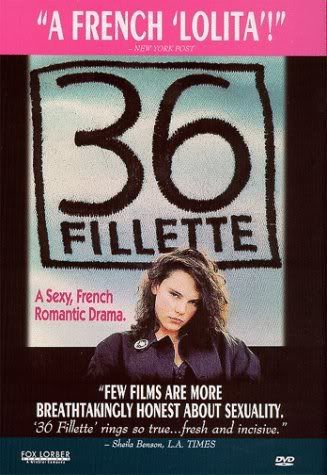


While I like Catherine Breillat, I have not yet been impressed with her films on adolecent sexuality. It's as if Breillat matured along with her films, culminating in the wonderful Romance and Anatomy of Hell. 36 Fillette, made relatively mid to early in Breillat's career, is another that I was disappointed with. Lili is 14, ready to be a woman, and is completely intolerable (to me). Breillat is brilliant in juxtaposing Lili's desire to be a woman (have sex) with everything else about her character, which is completely childish - she constantly whines, pouts, and fights with her brother, to the extent that it is often embarrassing and painful to watch. Although I am impressed with Breillat's formation of a character (which is probably autobiographical) in which woman and child live in relative harmony, I could not stand Lili, and wondered constantly why anyone would even choose to be around her. It might have been better to make Lili a more sympathetic image of young female sexuality, but, instead, we get brutal realism that doesn't even seem so real.

Lili tries (horribly) to seduce an older man, a real sleazy character who doesn't mind that she's 14. Lili is on again off again about her desire to have sex, but the man is pretty insistant, until Lili annoys even him. Her brother is almost as bad, but he's not on camera as much, so he's not that annoying. The best scene in the movie is between Lili and famous musician Boris Golovine (Jean-Pierre Leaud, whom everyone who reads this blog should know by now that I love). Boris listens to Lili's childish complaints and tries to give her useful life advice. Lili, of course, being 14, doesn't listen, but Boris' try is a noble and funny one nonetheless. All in all, not one of my favorite Breillat films, but one for completists like me.

6/10

RIYL: A Real Young Girl

Labels: ,

StumbleUpon Toolbar Stumble It!

Wednesday, November 15, 2006

Chocolat (Claire Denis, 1988)


Not to be confused with the Johnny Depp vehicle of the same name, Chocolat is the slow, intellectual portrait of a French family's life in colonial Cameroon, and all the racial and class politics that come with being a colonizer, no matter how liberal you may see yourself. It is the story of France, a young girl who has probably the most symbolic name in all of cinematic history, who lives with her mother and father in colonial Cameroon. The frame story involves France as an adult back in Cameroon (although we never know why, as Denis leaves France's life between childhood and adulthood a complete mystery, except for her comment that she is more or less a tourist in Cameroon), taking a ride with a local man and his son, who remind her of Protee, her family's houseservant as a child. She looks back at her childhood with the hindsight of an adult who sees now that the racial and class subjugation her family propagated onto the people of her town was wrong, even though her parents had nothing but the best intentions.

The story of France's childhood does not revolve around a single event, but chronicles her burgeoning awareness of her difference in this place. She and Protee (played by Isaach de Bankole, whose role here as the proud black outsider is in ways similar to the one he would later have in Lars von Trier's Manderlay) are almost playmates; he takes care of her and educates her, through action, about the Africans around her, but France does not really understand the power that she, as a white girl, has over these people. In one cute yet devastating scene, France feeds Protee some soup as if he was a baby, and even makes him eat some off her hand. She has no malice in these actions, but they are representative of the white liberal's position in African colonialism.

The emotions in the film are all below the surface, not represented to the audience as they are not to one another. The life of France's family is all superficiality, formal dinners and guests (who pose moral problems for different reasons, and are an interesting centerpiece to this slice of life). France's mother Aimee has this barely-hidden sensuality bursting out of her, which almost explodes onto Protee and several guests, but still remains completely internal. France's father has a genuine interest in Africa, but does not serve him well as the governor of their small town. One of the guests challenges everyone's view of Africans as subjugated, even if they don't think about it, but even Protee is so threatened by this that he forces the guest to leave.

Chocolat is an interesting portrayal of colonialism, the other side of a film like Black Girl that does not make the white colonizers look much better. In this film, however, they are real people, not easily ignored or hated. The Dalens family is easy to empathize with, something that makes their plight even more interesting. The cinematography is beautiful, but I would not recommend this for those without patience (as with other Denis films).

7/10

RIYL: The Lover (another interesting, although more erotic, portrayal of white people in a foreign, colonized land), Black Girl

Labels: ,

StumbleUpon Toolbar Stumble It!