Borderlands (Zev Berman, 2007): 6.5/10

The Magic Flute (Ingmar Bergman, 1975): 7/10

La Guerre Est Finie (Alain Resnais, 1966): 7/10

Speed Racer (The Wachowski Brothers, 2008): 8/10


My Photo
Name:
Location: milwaukee, wi

Saturday, March 29, 2008

The Cranes Are Flying (Mikhail Kalatozov, 1957)


I fond the above poster at Stale Popcorn, on the list of best film posters ever. I agree that the poster is gorgeous: effortlessly beautiful and symbolic, and still distinctly Soviet. That poster succeeds in portraying the film in a way that the American poster really doesn't. But no matter how beautiful the poster is, and how beautiful the movie itself is, I never felt myself particularly moved or swayed by the movie's actions.

Veronica and her fiancee Boris are torn apart by World War II, when Boris heroically enlists to help save his country. Veronica also loses her parents (in the one really emotionally resonant scene for me in the movie), and moves in with Boris' family, including his cousin Mark, who is hopelessly in love with Veronica. He's also a scumbag who won't take no for an answer, and tries to force himself time and time again on Veronica. The feminist/progressive defense of accepting a man because you can no longer hold your own in the world is an interesting and provocative one, but alas, Kalatozov doesn't really go that route. Veronica instead becomes a heroine of the war, working in a hospital with Boris' father. When the inevitable happens, it's sad, but not unexpected nor emotionally engaging. This seems more like a Soviet melodrama than a profound statement on war and female engagement in the world. The propagandist ending, with Veronica handing out flowers to her comrades and looking forward to a brave new world, was so ridiculous I actually laughed. For resonant drama, look elsewhere, but The Cranes Are Flying is beautifully photographed and has beautiful actors.

7/10

Labels: ,

StumbleUpon Toolbar Stumble It!

Tuesday, January 09, 2007

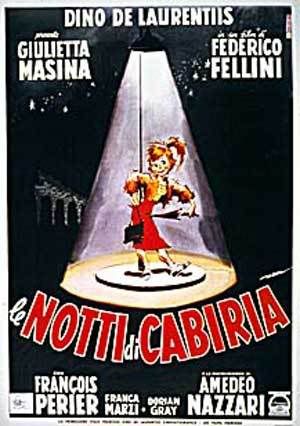
Nights of Cabiria (Federico Fellini, 1957)


This is another film that I feel sort of silly writing about; everything I want to say, I'm sure, has been said countless times and by better people than me. But in my estimation, Nights of Cabiria is Fellini's masterpiece, surpassing 8 1/2 by a pretty big margin. The story of tiny Cabiria, a Roman prostitute who will have you know that she owns her own house. She's been abused by every authority figure, from her mother, who started prostituting her at 15, to Georgio, who opens the film by pushing Cabiria in a river, nearly killing her, and running away with her purse. This man had spent a whole month with Cabiria just to do that, but she still believes in him for a while. She tries to explain the incident away, as maybe he had gotten scared when she fell in the river and ran away, but once he doesn't return for a few days, she finally gets the awful truth. This doesn't stop her from being any less optimistic about love, however, from her night with famous actor Alberto Lazzarri, to Oscar, the man she thinks she finally finds true love with.

Fellini sets Cabiria up for disappointment every single time, but we never end up hating him, nor does Cabiria's bad luck ever seem manufactured. She is just a woman who has been dealt a raw deal by life every single day, yet finds a way to persevere in spite of her desperate surroundings. In fact, Cabiria is the only one in her life who does not realize what kind of life she's living - from her friend Wanda (a beautiful perfomance by Franca Marzi) to the friend that tries to offer his pimping services to her, everyone seems to have an idea on how Cabiria could make her life better. She knows that only love will do that.

I was a bit reluctant to see this movie at first, even though it has such a sterling reputation, because I was pretty annoyed with Giulietta Masini's performance in La Strada (but less so in Juliet of the Spirits) - the extremely childlike, naive Gelsomina sorely grated on my by the end of the film. Masini takes Gelsomina's naive characteristics, but combines them with adult emotions and fragility to make Cabiria a fully developed, believeable person. Francois Truffaut said it best, I think: we love Masini (and Cabiria) in the movie because Fellini does, and translates that love to every single frame in the film. This is a movie of and about love, perfect and imperfect.

9/10

Labels: ,

StumbleUpon Toolbar Stumble It!